Niko Pirocmani
 Georgia
Biography of Niko Pirosmani
Niko Pirosmani, a prominent Georgian self-taught painter, was one of the most renowned artists of the 20th century and a representative of Primitivism. Much of Pirosmani's biography is not documented and is either known from his own words or reconstructed after his death.

Early Life and Education:
Pirosmani was born in 1862 in the village of Mirzaani in Kakheti, Georgia. He was the fourth and youngest child in a peasant family, with an older brother, Georgiy, and two sisters, Mariam and Peputsa. In 1870, Pirosmani's father died, followed by his mother and older brother shortly after. He then went to live with the widow of a Baku factory owner, Eprosina Kalantarova, in the village of Shulaveri. Pirosmani spent about fifteen years in the Kalantari family, first in Shulaveri and later in Tbilisi, along with Eprosina's son, Georgiy Kalantari. He learned to read in Georgian and Russian but did not receive any formal education. He briefly trained in a typography workshop but left and lived with Elyzavet Hankalamova (Eprosina's sister) and later her brother. It is believed that in 1876, he returned to Mirzaani for a short period and worked as a shepherd. Pirosmani gradually learned painting from itinerant artists who painted shop signs and dhurjanas (spiritual banners).
Artistic Career:
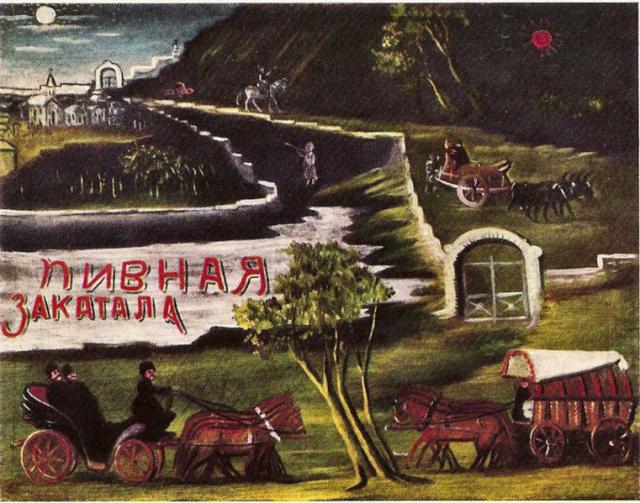
In the mid-1880s, Pirosmani opened a decorative painting workshop in Tbilisi with another self-taught artist, Gigo Zaziashvili. According to legend, they completed their first sign for free and did not receive any other orders. In 1890, Pirosmani worked as a brake conductor on a railway. However, he was frequently fined for various violations and resigned on January 17, 1894. He used his severance pay to open a dairy shop with his partner, Dimitri Alugishvili, and painted two signs for it, "White Cow" and "Black Cow." Despite owning the shop, Pirosmani did not have much interest in trading and often left to visit his relatives in Mirzaani. He gradually abandoned his trading activities around 1900 and began earning a living through his paintings.

Recognition and Later Life:
During his time, Pirosmani had a well-established reputation as an unstable person, making it difficult to work with him. He claimed to see saints and believed that his brush "paints on its own." He was often referred to as "out of this world" and "a man of seven Fridays." From 1895, he actively pursued painting, creating shop signs and decorative panels. Most of his works were painted with his own homemade pigments on glued canvas. Until 1912, Pirosmani had no contact with the art community in Tbilisi. However, in the summer of 1912, his work caught the attention of the Futurists, particularly Ilya Zdanevich, Kirill Zdanevich, and Mikhail Le-Dantyu. They purchased many of his paintings and promoted his work.
In 1913, Pirosmani's paintings were exhibited alongside those of well-known artists at the "Mishen" exhibition in Moscow. This brought some recognition to his work. In the same year, an article about Pirosmani titled "The Self-Taught Painter" was published by Ilya Zdanevich. In 1916, his works were exhibited in Tbilisi, and he was invited to join the newly established Society of Georgian Artists. Although Pirosmani gained relative popularity during this period, his financial situation did not improve. He lived in poverty, often spending nights in basements.
Niko Pirosmani passed away in Tbilisi on May 5, 1918, from hunger and illness. He spent his last three days in the basement of a house on Molokanskaya Street. His burial place remains unknown. Legends about Pirosmani's acquaintance with the Georgian poet Vazha Pshavela and his unrequited love for actress Margarita have no concrete evidence.
Legacy:
Pirosmani's most significant collections of works are housed in the State Museum of Oriental Art and the Tretyakov Gallery in Moscow, as well as the State Museum of Art in Tbilisi. In 1982, a house-museum dedicated to the artist was established in Mirzaani. Many of Pirosmani's works, both preserved and lost, are shop signs. In Tbilisi at the beginning of the 20th century, shop signs were a popular genre, and Pirosmani often used a black background for both signs and portraits. His portraits were often painted based on photographs, such as the portraits of Ilya Zdanevich and Alexander Garanov.
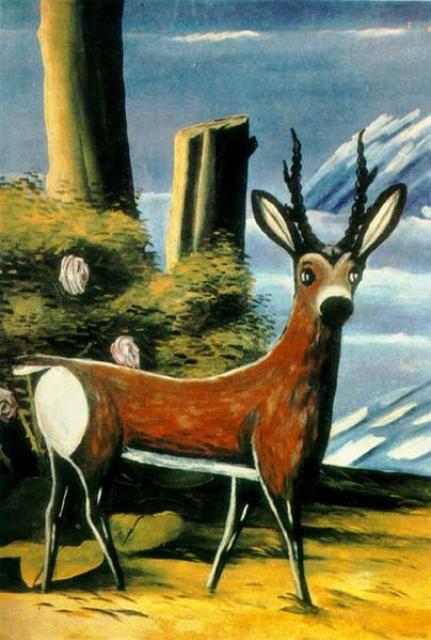
Animals were also a prominent subject in Pirosmani's work, though they were not always true to their real-life counterparts. As noted by Lado Gudiashvili, the animals in Pirosmani's paintings had the eyes of the artist himself. Pirosmani frequently depicted animals in a three-quarter turn.
Another recurring theme in Pirosmani's work was scenes of celebration or feasts. These scenes contrasted sharply with the artist's impoverished existence.
Despite his struggles and hardships, Niko Pirosmani left behind a significant artistic legacy that continues to captivate audiences worldwide.