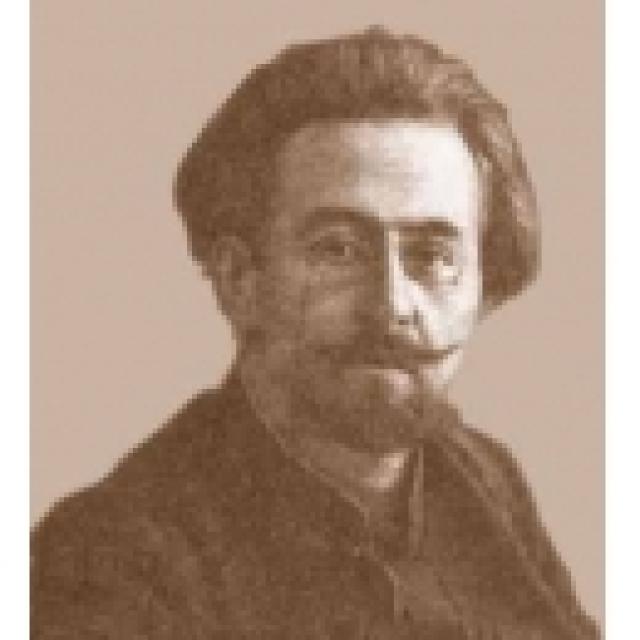
Nikolay Artsybushjev
 Russia
- Early Life and Musical Education
- Compositions and the Belyaev Circle
- The Belyaev Publishing Council
- Exile and Later Years
- Legacy
Nikolai Artsybushev was a trained lawyer who became an important organizer of Russian musical life. His own compositions ranged from orchestral dances and piano pieces to songs, but his lasting influence came largely through the work he did behind the scenes: helping preserve and promote the music of Russian composers through the Belyaev circle and its publishing council. After the Revolution, he carried that work into exile, first through Finland and then to Paris.
Early Life and Musical Education
Nikolai Vasilievich Artsybushev was born on March 7, 1858, in Tsarskoye Selo, near St. Petersburg. He pursued a legal career while also studying music. He received composition and theory instruction from Nikolai Rimsky-Korsakov and Anatoly Lyadov, becoming part of the close musical world surrounding St. Petersburg’s composers and patrons.
Artsybushev’s path was unusual for a composer of his circle: music was not his only profession. His legal training later proved useful in administrative work, especially when artistic institutions faced financial and political upheaval. At the same time, he composed steadily, developing a modest but varied catalogue.
Compositions and the Belyaev Circle
Artsybushev’s published works included the Characteristic Polka and Valse-Fantaisie for orchestra, piano works such as mazurkas and preludes, and romances for voice and piano. He also contributed to collaborative projects associated with the Belyaev circle, a group of composers who gathered around the patron and publisher Mitrofan Belyaev. For these collective collections, Artsybushev wrote variations on Russian themes, a string-quartet serenade, and a contribution to a light-hearted piano quadrille.
He was not as prolific or widely celebrated as the leading composers in the circle, but his musical relationships placed him at the center of an influential network. His work as a publisher and organizer helped create practical support for composers whose music might otherwise have struggled to reach performers and listeners.
The Belyaev Publishing Council
The Belyaev circle’s influence depended not only on composing but on building institutions to publish, perform, and reward Russian music. Artsybushev became a member of the council created to support composers and musicians. After Rimsky-Korsakov’s death, he took over as its chairman in 1909, helping oversee the foundation and its publishing interests.
His legal and administrative skills became especially valuable after the Russian Revolution. The new authorities nationalized the council’s assets, putting its resources and future in doubt. Artsybushev worked to establish the council’s legal standing and to preserve its publishing operation. He traveled through Finland and Germany as part of efforts to reconstitute the organization and maintain its connection to the M. P. Belaieff publishing house.
Exile and Later Years
Around 1920, Artsybushev left Russia and eventually settled in Paris. There, he continued the council’s work in exile, helping keep Russian music publishing alive despite the upheaval that had scattered its members and disrupted its finances. The task required diplomacy and persistence: the original council members were dispersed across different countries, and its assets had been taken over at home.
He lived in Paris until his death on April 15, 1937. His own music remained comparatively little known, but his work as a guardian of the Belyaev legacy gave him an enduring place in the history of Russian musical culture.
Legacy
Artsybushev’s story illustrates how cultural history is shaped by more than famous scores and celebrated premieres. He wrote music of his own, yet his most lasting contribution came from using his professional skills to protect the institutions that supported other composers. Through the Belyaev council and publisher, he helped sustain a network that had brought Russian music to audiences at home and abroad. His career joined composition, law, and cultural stewardship at a moment when all three were tested by revolution and exile.


