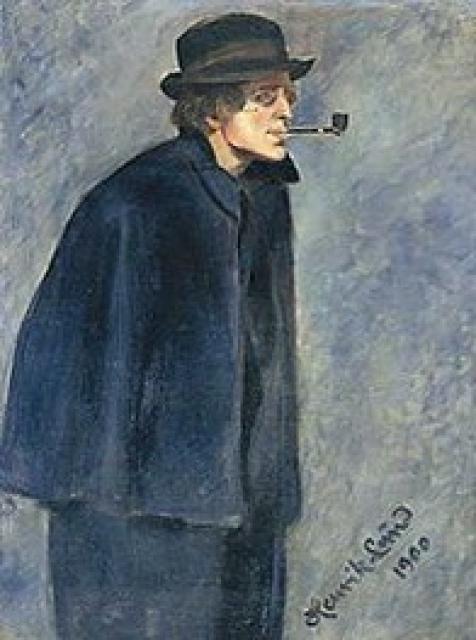
Nikolay Astrup
 Norway
- Early Life and Education
- Artistic Development
- Career and Success
- Travels and Exhibitions
- Artistic Style and Legacy
- Death and Legacy
Early Life and Education
Nikolai Astrup, a celebrated Norwegian painter, was born in 1880 in Bremanger, Western Norway. In 1883, his family moved to Jølster, where his father became a vicar. In 1895, Astrup attended a classical gymnasium in Trondheim but returned to Jølster in 1897 to tutor his siblings. During this time, he began painting with no formal training.
Artistic Development
In 1899, Astrup enrolled in art school in Christiania. He later took lessons at a private school founded by Harriet Backer. In 1901, he received a scholarship to travel through Europe, visiting cities such as Lübeck, Dresden, Berlin, and Munich. In December, he arrived in Paris and studied at the Académie Colarossi under Christian Krohg.
Career and Success
In 1902, Astrup returned to Norway and settled in Jølster, where he lived for most of the next decade. He held his first solo exhibition in Christiania in 1905, which was met with critical acclaim. One of his paintings was acquired by the National Gallery that year. Astrup married Engel Sunde in 1907, and they had eight children.
Travels and Exhibitions
In addition to his 1905 debut, Astrup had two other solo exhibitions during his lifetime: in Bergen in 1908 and Christiania in 1911. Both were enthusiastically received by art critics. He traveled extensively, including visits to London (1908), Berlin (1911), Copenhagen and Stockholm (1916), and Algeria (1922-23).
Artistic Style and Legacy
Astrup's distinctive style is characterized by a blend of realistic landscapes and fantastical elements. Mountains and trees often take on anthropomorphic forms, and a recurring motif is a celebration scene with a bonfire in the background observed by a seated figure in the foreground, often a child representing the artist himself. His legacy includes a substantial body of paintings and graphic works, many of which depict scenes from his surroundings in Jølster.
Death and Legacy
Astrup died in 1928 at the age of 47 from pneumonia, a complication of his lifelong asthma. In 1967, the municipality of Jølster acquired his former farm on the shores of Lake Jølstravatn, which was transformed into the Astruptunet Museum. His art continues to be celebrated for its unique style and enduring themes of nature, childhood, and rural life.



