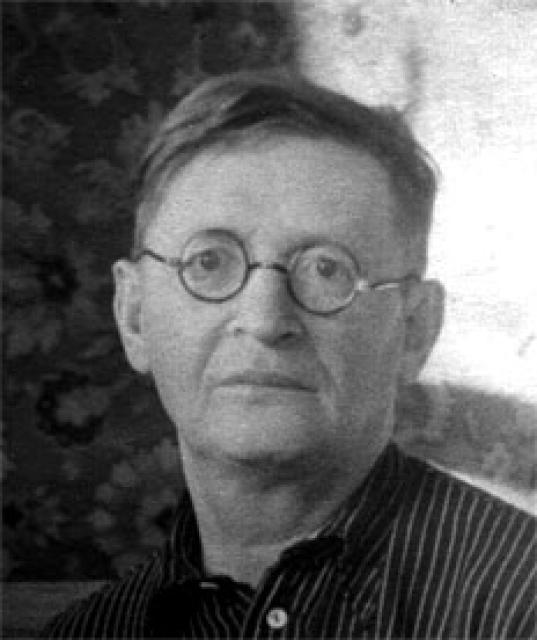
Nikolay Gorban
 Uzbekistan
- Biography of Nikolay Gorbany
- Early Career
- Political Persecution and Rehabilitation
- Later Career and Contributions
- Legacy
Biography of Nikolay Gorbany
Nikolay Vasilyevich Gorbany was a Soviet historian, archivist, and writer. He was born on December 8, 1899, in the village of Nikolaevka in the Konstantinogradsky District of the Poltava Governorate. His parents were rural teachers. Gorbany graduated from the Kobylyaky Gymnasium with a gold medal in 1917 and completed his studies at the Historical and Philological Faculty of Kharkov University in 1921. He was a student of academician D.N. Bagaley.
Early Career
After completing his education, Gorbany worked as a research fellow at the Department of the History of Ukrainian Culture at the Kharkov Institute of Popular Education, which later became a university. In 1929, he was elected as a scientific secretary and corresponding member of the Archaeological Commission of the Academy of Sciences of Ukraine. He also engaged in research on Ukrainian-Turkish relations at the Institute of Oriental Studies.
Political Persecution and Rehabilitation
In April 1931, Gorbany was falsely accused and arrested in the case of the "Ukrainian National Center" or the "Grushevsky Case." After ten months of imprisonment in Ukraine, he was charged and sentenced under the articles 54-10 and 54-11 of the Criminal Code of the Ukrainian SSR and the article 58/11 of the Criminal Code of the RSFSR. He was sent into exile in Alma-Ata for three years (1932-1934) and then in Tobolsk for another three years (1934-1937). Gorbany was later rehabilitated.
Later Career and Contributions
Despite facing multiple periods of unemployment, Gorbany continued his scholarly activities. He worked as a teacher of literature and German language in secondary schools, Latin language in medical colleges and institutes, and as a staff member of the Omsk State Archive. In 1946, he defended his candidate dissertation on the "Peasant Uprising of 1773-1775 in Western Siberia" at Leningrad State University. Gorbany was awarded the medal "For Valiant Labor in the Great Patriotic War" in 1950.
From 1960, Gorbany served as an associate professor at the Department of Foreign Languages at the Tashkent Medical Institute and later became the head of the department at Tashkent University. During this time, he wrote several articles on the history of the teaching of Latin language in Tashkent Gymnasium and the Tashkent legend of Pugachev.
Legacy
Gorbany authored numerous books, brochures, and hundreds of articles. His works covered a wide range of topics, including the history of culture, the history of Siberian peoples, and the history of the church. Despite facing political persecution, Gorbany remained committed to his scholarly pursuits throughout his life. He was recognized as one of the pioneers of the historical genre in Ukrainian Soviet literature.
Gorbany's son, Alexander Nikolaevich Gorbany, became a renowned mathematician, and his granddaughter, Anna Alexandrovna Gorbany, is a talented artist. Nikolay Vasilyevich Gorbany passed away on April 19, 1973, in Tashkent. His contributions continue to be recognized, and his name is honored through scientific readings and awards in the field of historical and archival research.



