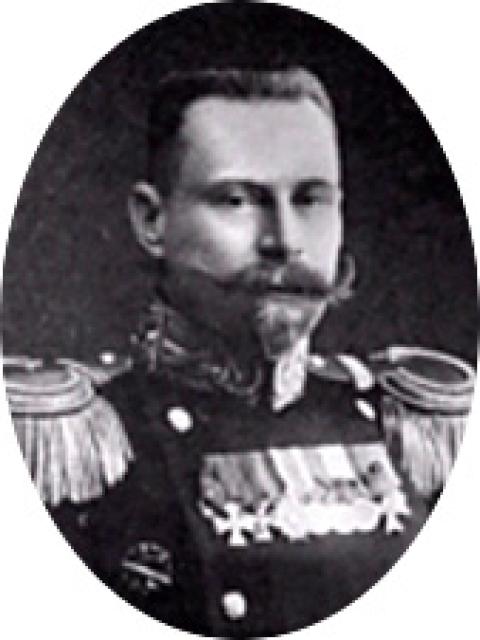
Nikolay Kolomeitsev
- Early Life and Career
- Naval Expeditions and Achievements
- Battle of Tsushima and Aftermath
- Later Career and Legacy
- Life in Exile
- Family
Early Life and Career
Nikolai Nikolai Ivanovich Kolomyetsev, a Russian vice admiral, was a notable participant in the Battle of Tsushima. His military service began in 1884. On September 29, 1887, he became a midshipman, and on December 13, 1893, he achieved the rank of lieutenant "for distinction."
Naval Expeditions and Achievements
Kolomyetsev's early career involved various naval expeditions. In 1893, he navigated the steamship "Lieutenant Ovtsyn" from the United Kingdom to the Yenisei River estuary. He completed the Mine Officer Class in 1894 and embarked on a voyage to the Pacific Ocean aboard the cruiser "Gaidamak" (1894-1895). In 1896, he became a 1st class mine officer.
From 1900 to 1901, Kolomyetsev served as commander of the yacht "Zarya" during Baron Eduard von Toll's polar expedition. Despite disagreements with Toll, he left the ship and trekked approximately 800 kilometers to Golchikha (Yenisei Bay) with Stepan Rastorguev in just 40 days. During this journey, he discovered the Kolomyetsev River, which flows into the Taimyr Gulf.
Battle of Tsushima and Aftermath
In July 1904, Kolomyetsev commanded the destroyer "Buinyi" as part of the 2nd Pacific Squadron. During the Battle of Tsushima (May 14-15, 1905), he rescued over 200 men from the sinking battleship "Oslyabya."
On May 14, realizing that the flagship battleship "Kniaz Suvorov" was engulfed in flames and severely listing, Kolomyetsev's "Buinyi" approached the windward side of the "Suvorov" and evacuated the wounded Vice Admiral Zinovy Rozhdestvensky and the staff of the 2nd Pacific Squadron. Rozhdestvensky then transferred to the destroyer "Bedovy."
Hours later, with the squadron commander aboard, the "Bedovy" surrendered to two Japanese cruisers without a fight. According to some accounts, Kolomyetsev survived the sinking of the "Buinyi" and ended up on the cruiser "Dmitri Donskoi," where he was severely wounded and taken prisoner by the Japanese. However, other sources claim that he salvaged his ship and crew when it was in a perilous situation and indignantly threw a white surrender flag overboard.
Later Career and Legacy
After the Russo-Japanese War, Kolomyetsov rose through the naval ranks. He became senior officer of the battleship "Andrei Pervozvanny" in 1906 and graduated from the Naval Academy in 1908. From 1908 to 1910, he commanded the yacht "Almaz."
Kolomyetsev continued his military career as commander of the battleship "Slava" (1910-1913). He was promoted to rear admiral in 1913. During World War I, he served as commander of the Baltic Fleet's cruiser brigade (1914) and commander of the Chudskoye Military Flotilla (1915-1917).
Kolomyetsev retired from the navy in 1917 with the rank of vice admiral. He was arrested by the Bolsheviks and imprisoned in the Peter and Paul Fortress. In late 1918, he escaped across the frozen Gulf of Finland to Finland and later relocated to the Black Sea.
Life in Exile
Kolomyetsev joined the Volunteer Army and the Armed Forces of South Russia during the Russian Civil War. He commanded Black Sea icebreakers. After emigrating to France, he became a member of the Union of Former Naval Officers and vice chairman of the Union of Knights of St. George in France.
On October 6, 1944, he was tragically killed in Paris when he was struck by an American army truck. Kolomyetsev was buried in the Sainte-Geneviève-des-Bois Cemetery.
Family
Kolomyetsev's wife, Nina Dmitriyevna Nabokova (1860-1944), was the aunt of the writer Vladimir Nabokov, who mentioned him in his memoir "Speak, Memory." Kolomyetsev was set to be Nabokov's second in a planned duel with Mikhail Suvorin, the editor of "Novoye Vremya."