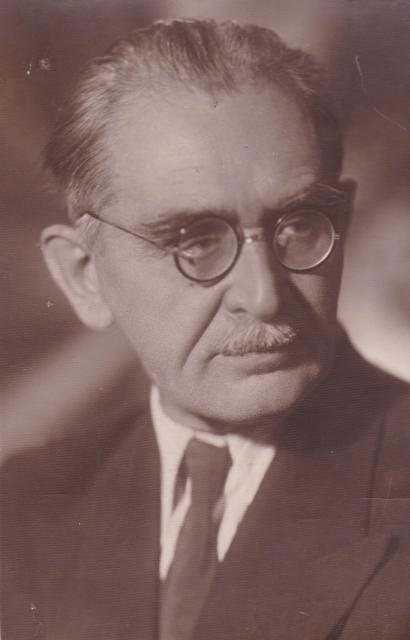
Nikolay Kolosovsky
- Early Life and Education
- Work in Government Planning
- Hydropower Development (1931-1936)
- Academy of Sciences Tenure (1936-1946)
- Post-War Academic Career
- Conceptual Framework Development
- Legacy and Recognition
Nikolai Nikolaevich Kolosovsky: Soviet Economic Geographer and Economist
Early Life and Education
Nikolai Nikolaevich Kolosovsky was born in the family of an employee of the Nizhny Novgorod Fair Administration. He graduated from the St. Petersburg Institute of Railway Engineers in 1916 and was sent to the Trans-Baikal District to construct strategic railroads.
Work in Government Planning
From 1921 to 1931, Kolosovsky worked in the USSR State Planning Committee (Gosplan), where he focused on economic zoning and the development of schemes for studying and utilizing resources in Siberia and the Far East. He played a significant role in the creation of the Ural-Kuznetsk Combine, Trans-Siberian Railway, Angarostroy, and the focal development of the North.
Hydropower Development (1931-1936)
Kolosovsky joined the Institute of Hydropower Projects (Gidroenergoproekt) from 1931 to 1936. He developed the project for the creation of Angarostroy, including its first stage known as the Baikal-Cheremakhovsky energy-industrial complex.
Academy of Sciences Tenure (1936-1946)
Kolosovsky worked in the Academy of Sciences of the USSR (AN SSSR) from 1936 to 1946, particularly in the Council for the Study of Productive Forces (SOPS). During World War II, he oversaw the deployment of the military industry in the Urals and addressed the related transportation issues.
Post-War Academic Career
After the war, Kolosovsky dedicated himself to teaching. He became a professor at the Department of Economic Geography of the USSR at the Geography Faculty of Moscow State University (MGU), where he lectured from 1931. He also taught at the Plekhanov Institute of National Economy earlier on.
Conceptual Framework Development
Kolosovsky developed an original course on economic zoning and created the conceptual framework of the Soviet regional school of economic geography. He introduced essential concepts such as the energy-production cycle (a combination of industries linked by raw materials and energy), territorial-production complex (a group of industries whose co-location leads to additional economic benefits), and the theory of economic zoning.
Legacy and Recognition
Kolosovsky's contributions to the field of economic geography were significant. He coined the terms "territorial-production complex" (TPC) and "energy-production cycle" (EPC). He received the Stalin Prize of the first degree in 1942 for his work. Kolosovsky is buried at Vagankovo Cemetery in Moscow.