Nikolay Krotkov
- Metropolitan of Kostroma and Galich
- Early Life and Education
- Priestly Service
- Monastic Vocation and Episcopal Career
- Political Views and Controversies
- Arrest, Imprisonment, and Exile
- Continued Suppression and Martyrdom
- Canonisation
Metropolitan of Kostroma and Galich
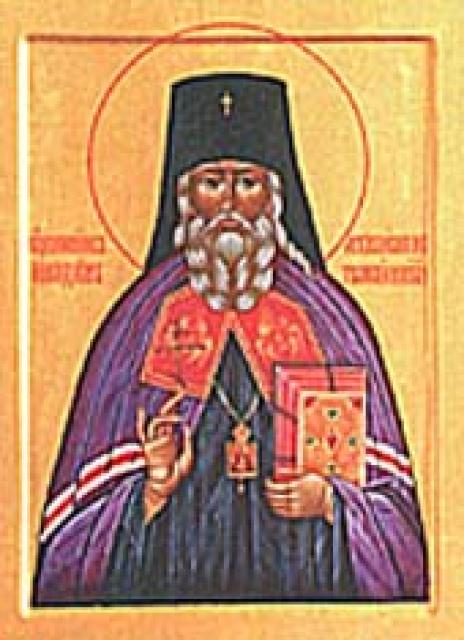
Metropolitan Luke (Voino-Yasenetsky) was the Archbishop of Kostroma and Galich. He was canonised as a saint of the Russian Orthodox Church in 2000.
Early Life and Education
Luke was born into a poor family of a rural priest. After the death of his young child and then his wife, he entered the spiritual academy, choosing the monastic path. He graduated from the Kostroma Theological Seminary (1889) and the Kiev Theological Academy (1900) with a degree in Theology. He served as a teacher at a parish school from 1889.
Priestly Service
On February 25, 1890, Luke became a priest at the Peter and Paul Church in the village of Tezino. His parishioners were mainly workers. He introduced spiritual readings and teachings into the church, often followed by an Akathist service. He also displayed musical talent.
Monastic Vocation and Episcopal Career
In 1899, Luke was tonsured a monk and elevated to the rank of hierodeacon and hieromonk. From 1900, he served as the superintendent of the Vladikavkaz Theological School. In 1902, he became archimandrite and rector of the Alexander Ardon Mission Seminary (in Ossetia).
From 1905, Luke became the rector of the Pskov Theological Seminary. On November 11, 1907, he was consecrated Bishop of Akkerman, the vicar of the Kishinev diocese. From November 16, 1911, he became Bishop of Chigirin, the vicar of the Kiev diocese, and the abbot of the St. Michael's Golden-Domed Monastery.
Political Views and Controversies
Luke held right-wing political views. In February 1917, he joined other right-wing Kiev clergy in appealing to the Tsar to dissolve the State Duma. After the February Revolution, he was exiled to Saratov, but was reinstated through the intercession of secular and church leaders in Kiev. He supported a united and indivisible Russia, which brought him into conflict with Ukrainian nationalist leaders seeking autocephaly.
Arrest, Imprisonment, and Exile
In 1918, Luke was arrested by supporters of Simon Petliura and spent nine months in captivity, initially in Galicia and then in Poland, alongside Metropolitan Anthony (Khrapovitsky) and Archbishop Eulogius (Georgievsky).
In 1919, Patriarch Tikhon appointed Luke as Archbishop of Taurida and Simferopol. He crossed the front line and arrived in Crimea in June 1920. Despite opportunities to flee Russia during the evacuation of White troops, he chose to remain with his flock. He formally took charge of the diocese in 1921.
Continued Suppression and Martyrdom
In 1922, Luke was arrested for resisting the seizure of church valuables and sentenced to eight years in prison. He contracted typhus and was hospitalised, but was released in 1923 under an amnesty. He moved to Moscow, where he was arrested again and exiled to Turkestan for two years. In 1926, he was released but soon rearrested and sent to Turkestan again, first to Kyzyl-Orda and then to Turtkul.
After his release in 1929, Luke was denied the right to reside in major cities and Ukraine. He settled in the village of Tezino, where he had begun his priestly journey.
On July 10, 1932, Luke became Archbishop of Kostroma and Galich. He continued to support exiled hierarchs and priests, and rescued the miraculous icon of Feodorovskaya after the destruction of the cathedral. He gathered around him clergy who had survived prison and exile and remained faithful to Orthodoxy.
On the night of December 4, 1936, Luke was arrested and sentenced to exile in the Krasnoyarsk region for five years. False testimony was given against him by his secretary. However, due to his poor health, he was not sent into exile. Instead, he was kept in prison, where he was charged with counter-revolutionary activities. Repeated night interrogations severely weakened his health. He died on June 11, 1937, in the Yaroslavl prison hospital.
Canonisation
Luke was canonised in the Kostroma diocese in 1995 as a locally revered saint. He is honoured as part of the Council of Kostroma Saints. He was elevated to the ranks of the Holy New Martyrs and Confessors of Russia at the Jubilee Bishops' Council of the Russian Orthodox Church in August 2000 for universal veneration.


