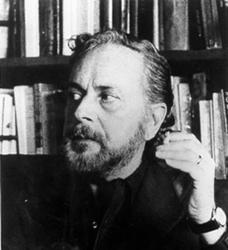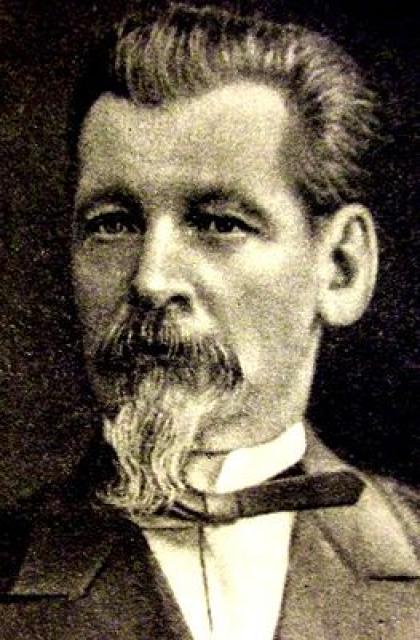
Nikolay Shelgunov
 Russia
- Early Life and Education
- Marriage and Intellectual Pursuits
- Return to Petersburg and Literary Breakthrough
- Service in the Forest Department and Break with Colleagues
- Beginning of Publicistic Activity
Early Life and Education
Nikolai Vasilyevich Shelgunov (1824-1891) was a renowned writer. His great-grandfather and grandfather were sailors, while his father worked in the civil service. Shelgunov grew up during the reign of Nicholas I and witnessed firsthand the regime's oppressive practices. When he was three, his father died, leaving the family destitute. The young boy was sent to the Aleksandrovsky Cadet Corps for minors, where he remained until the age of nine. His only memories from this school were of physical punishments.
In 1833, Shelgunov was enrolled at the Forest Institute. The initial period of his stay at the institute, under the administration of Finance Minister Kankrin, was positive. The environment was liberal, and students pursued their studies with enthusiasm. Professors of Russian literature, A.A. Komarov and Sorokin, introduced the students to contemporary works and fostered their love of literature. However, the introduction of military organization changed the atmosphere, making it more rigid and harsh. Discipline and military training became a priority for both students and instructors. Nevertheless, Shelgunov acknowledged that this "military civilization" had its merits, instilling a sense of chivalry and camaraderie.
Shelgunov graduated with distinction, earning the rank of second lieutenant and the title of forest surveyor. He entered the service of the Forest Department. During the summers, he traveled to various provinces for forest management, staying in villages and immersing himself in the lives of the common people. He returned to St. Petersburg during the winters to pursue his theoretical studies. Shelgunov's early literary works focused on forestry. His first articles appeared in "Syn Otechestva." He also published specialized articles in "Biblioteka dlya Chteniya."
Marriage and Intellectual Pursuits
Within the first few years after graduating, Shelgunov found his future wife, his second cousin L.P. Mikhaëlis. He recommended books to her and wrote her letters that were remarkable for their sincere and persistent desire to clarify relationships between men and women. The couple married in 1850.
In 1849, Shelgunov was sent to Simbirsk Governorate to establish a forest land property. During the winter, he was assigned to the local administration of state lands in Samara. At that time, Samara was experiencing a period of civil progress, according to Shelgunov's observations. The local administration included individuals of integrity who brought the teachings of their mentors, Granovsky and Meyer, to the provinces. Shelgunov formed a close friendship with P.P. Pekarsky. In Samara, Shelgunov attended social gatherings, played the violin and clarinet at amateur concerts, and worked on his extensive treatise on the history of Russian forestry legislation.
Return to Petersburg and Literary Breakthrough
Returning to St. Petersburg in 1851, Shelgunov resumed his employment with the Forest Department. During this period, he established strong connections within literary circles. His acquaintances with N.G. Chernyshevsky and M.L. Mikhailov soon blossomed into close friendships. In 1856, Shelgunov was offered a position at the Lysinsky Training Forestry, a practical class for officers of the Forest Corps. The academic forester was expected to supervise practical work in the summer and deliver lectures in the winter. Shelgunov did not consider himself sufficiently prepared for these responsibilities and insisted on an assignment abroad.
This journey abroad marked a turning point in Shelgunov's worldview. As an elderly man, he recalled this period with great enthusiasm: "What an exciting and overwhelming time! I literally wandered in a trance, rushing somewhere forward, toward something else, and that something else seemed to be just beyond the gate separating Russia from Europe." In Shelgunov's life, his trip abroad was the moment when "a single new word, a single new concept, produces a radical change, and everything old is thrown overboard." He studied Russia while abroad through printed material, as he had previously been unfamiliar with its geography or history.
In Ems, Shelgunov met Dr. Lovtsov, who introduced him to the writings of Alexander Herzen. In Paris, he joined a circle that included Jenny d'Héricourt, a renowned advocate for women's emancipation. The time spent in Paris transformed Shelgunov and his wife. After one brief conversation with Shelgunov's wife, a Russian lady remarked, "You reek of hard labor."
Service in the Forest Department and Break with Colleagues
Upon his return from abroad, Shelgunov continued his service in the Forest Department. A curious episode during this period was his relationship with M.N. Muravyov, who was appointed Minister of State Properties in 1857. Shelgunov accompanied Muravyov on an inspection tour across Russia, which resembled an invasion. Shelgunov's workload was immense. Even while traveling, he was required to present his reports the following day. For any delay, Muravyov punished Shelgunov by ordering him to travel separately from his entourage. Upon their arrival in St. Petersburg in the fall of 1857, Muravyov appointed Shelgunov head of a department in the Forest Department. Shelgunov's official duties were overwhelming, and he additionally edited the journal "Lesovodstvo i Okhota" (Forestry and Hunting).
Muravyov valued his subordinate and often summoned him even at night to clarify various issues. However, working with Muravyov was extremely challenging. When Muravyov's nephew became director of the department and "terrible chaos ensued," Shelgunov decided to leave the department. Instead of a resignation, he was given a foreign leave of absence in May 1858.
This time, Shelgunov remained abroad for about a year and a half. For some time, he traveled with his friend Mikhailov. As before, Shelgunov dedicated much of his time to forestry, studying the practical aspects of forest management in Western European countries. He also visited Herzen in London with Mikhailov and met with him again in Paris later on.
Upon his return from abroad, Shelgunov drafted a proposal to transform the Forest Corps into an institution of higher learning. He briefly served as a professor at the institute, teaching the history of forestry legislation. By this time, however, his interest in forestry had waned. The unpleasant situation Shelgunov faced within the Forest Department was compounded by the intrigues of colleagues. His articles "Materials for a Forest Statute" and "Forest Laws in Western Europe," published in "Yuridichesky Vestnik" (Law Journal) in 1861, were Shelgunov's final works on forestry. He resigned from the service in March 1862, with the rank of colonel of the Forest Corps.
Beginning of Publicistic Activity
Even before his resignation, Shelgunov had become a contributor to "Russkoye Slovo" (Russian Word) in 1859. During this period, the concept of "liberation" was paramount: emancipation from serfdom was seen as a gateway to liberation from traditional Moscow values. "We simply aspired to space, and each liberated himself as he could and wherever he could," Shelgunov wrote. This reaction against state, societal, and family oppression, this "negation of foundations," was carried out in the name of specific positive ideals. The ideals of the future were not only political in nature, but also socio-economic. The press at this time was a powerful force, and progressive literature introduced ideals of the future into society's consciousness.
Shelgunov's publicistic career began in "Sovremennik" (The Contemporary) when Dobrolyubov and Chernyshevsky were at the helm of the journal. Shelgunov's articles in this journal included "The Working Proletariat in England and France." While the content of these articles was not particularly original (they were based