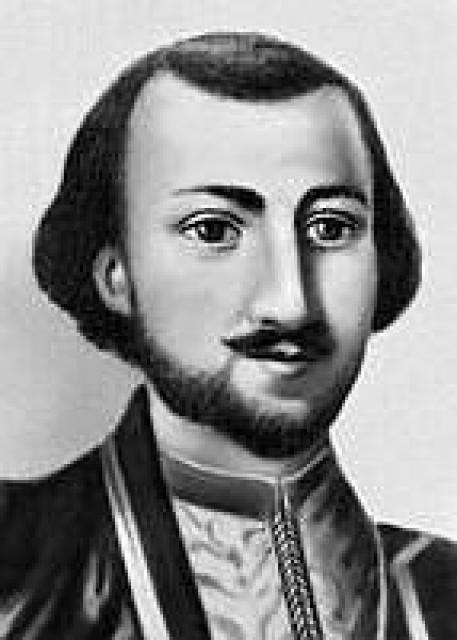
Nikolos Baratashvili
 Georgia
Biography of Nikoloz Baratashvili
Nikoloz Baratashvili was a Georgian poet and romantic. He was born on December 15, 1817, in Tbilisi, in a noble family. After graduating from the Tbilisi Noble School in 1835, where he was inspired by the ideas of humanism and national freedom, the poet was forced to become a civil servant in the judicial department, perceiving his service as humiliation.
In the early 1840s, Baratashvili gained fame as a poet, but his poems were first published only in 1852 in the journal "Tsiskari". In 1844, after his father's complete ruin, Baratashvili moved to work in Nakhchivan, and then to Ganja (Azerbaijan), where he fell ill with a malignant fever and died on October 9, 1845, at the age of 27. In 1893, Baratashvili's remains were brought back to his homeland and buried in Tbilisi, in the Didube Pantheon of Georgian writers, and in 1938, they were moved to the pantheon on Mtatsminda Mountain.
Poetry of Nikoloz Baratashvili
The poetry of Nikoloz Baratashvili represents the peak of Georgian romanticism. He left only about 40 poems and one epic poem. Like a brilliant artist, Baratashvili managed to express the complex inner world of man in his poems and provide answers to the most pressing questions of his time. He heavily mourned Georgia's loss of national independence and was disappointed in the contemporary society. The feelings of loneliness, which permeate his early poems ("Twilight on Mtatsminda," 1836, "Reflections on the Banks of the Kura," 1837), reach a tragic tone in the poem "Lonely Soul" (1839).
However, the tragic conflict with reality is combined with a deep faith in the triumph of reason and justice. This prophetic gift of the poet is most vividly embodied in Baratashvili's masterpiece of philosophical lyricism, "Merani" (1842). The lyrical hero of the poem, a rider on a winged horse, defies fate and rushes into the unknown distance, saying, "I am weak, but I am not a slave to my destiny." This is the impulse of a rebellious, freedom-loving personality, a readiness for self-sacrifice, a hymn to the free and powerful spirit of Man. The symbolism of "Merani" is multivalent. The hero's confidence in his destiny and his desire to pave the way to happiness for future generations are a bright expression of the will of the Georgian people for national and social liberation.
Reflections on eternal problems of life, delicate movements of the soul found expression in artistically perfect poems such as "Mysterious Voice," "My Prayer," "I Found a Temple in the Sands, Amidst Darkness...", "Evil Spirit," "Heavenly Color, Blue Color," and others. Baratashvili's poetic legacy is particularly distinguished by the poem "The Fate of Georgia" (1839), which depicts the invasion of the Iranian Shah Agha Mohammad Khan on Tbilisi in 1795. In the poem, Baratashvili realistically evaluates King Heraclius II's decision to join Georgia to Russia as historically necessary and progressive.
Nikoloz Baratashvili renewed the poetics of Georgian verse, creating examples of reflective poems characterized by philosophical depth, enchanting plasticity, musicality, and expressiveness. Boris Pasternak, who translated Baratashvili's poems into Russian, wrote: "... The genius that permeates Baratashvili's poems gives them their ultimate perfection." The works of Nikoloz Baratashvili, the greatest poet of Georgia after Shota Rustaveli, inspired many generations of Georgian writers.


