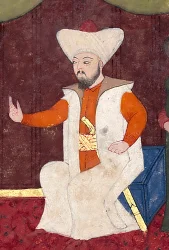
Nur ad-Din
Nur al-Din Mahmud ibn Zangi was a twelfth-century ruler who brought much of Syria under his authority and became one of the principal opponents of the Crusader states. His campaigns and political legacy helped prepare the ground for the rise of Saladin, who later ruled Egypt and Syria.
Heir to a divided realm
Nur al-Din was born in Aleppo on 11 February 1118, the son of the military leader Imad al-Din Zangi. When Zangi was assassinated in 1146, his territories were divided between his sons. Nur al-Din took control of Aleppo and the Syrian lands, while his brother inherited Mosul.
He continued his father’s struggle against the Crusader states established after the First Crusade. In 1149 he defeated and killed Raymond of Poitiers, prince of Antioch, at the Battle of Inab. Over the following years he expanded his influence and presented himself as a defender of Muslim lands, while also competing with other rulers for control of Syria.
Unifying Syria and reaching toward Egypt
Damascus had long balanced between regional powers and the Crusader kingdom of Jerusalem. Nur al-Din captured it in 1154, bringing the two most important Syrian centers under a single ruler. He strengthened his rule through military campaigns as well as patronage of mosques, schools, hospitals, and public works. The Nur al-Din Hospital in Damascus became one of the city’s prominent medical institutions.
In the 1160s he turned his attention to Egypt, where the Fatimid caliphate was weakening and the Crusaders were seeking influence. Nur al-Din sent military expeditions led by his commander Shirkuh; Shirkuh’s nephew Saladin served in these campaigns. After Shirkuh’s death in 1169, Saladin became vizier in Cairo and in 1171 ended Fatimid rule, expanding the reach of the Sunni institutions Nur al-Din had supported.
Final plans and legacy
Nur al-Din died in Damascus on 15 May 1174, while preparing for a campaign toward Egypt. His young son inherited his territory, but the power vacuum soon drew Saladin into Syria. In the years that followed, Saladin consolidated the lands once ruled by Nur al-Din and led the campaign that culminated in the recapture of Jerusalem.
Medieval Muslim writers remembered Nur al-Din as a pious and just ruler, and his public buildings left a lasting mark on Syrian cities. His career combined military expansion with political and religious institution-building, helping shape the regional order that followed the Crusades.