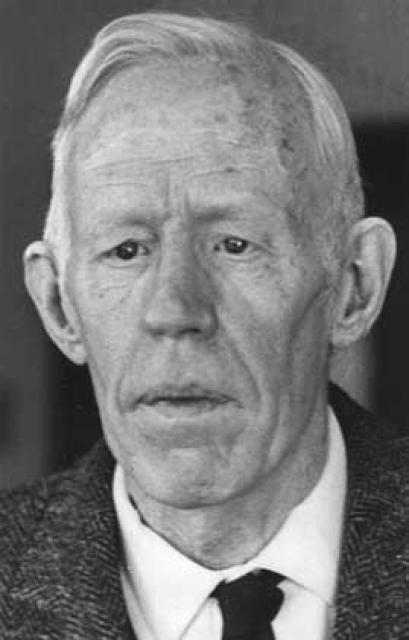
Odd Hassel
 Norway
Odd Hassel was a Norwegian physical chemist whose work helped explain how the three-dimensional shapes of molecules influence their behavior. His research on cyclohexane and related compounds laid important foundations for conformational analysis, the study of the different shapes a molecule can adopt. In 1969, he shared the Nobel Prize in Chemistry with British chemist Derek Barton.
Education and early research
Hassel was born in Kristiania, now Oslo, on May 17, 1897. He studied chemistry at the Royal Frederick University in Kristiania, graduating in 1920. He continued his training in Europe, working in Munich and at the Kaiser Wilhelm Institute in Berlin, where he earned a doctorate in 1924.
His time in Berlin introduced him to X-ray crystallography, a method for determining the arrangement of atoms in crystals. Hassel returned to Oslo in 1925 and joined the university as a research fellow. He later worked with techniques including electron diffraction to examine the structures of molecules.
A new understanding of molecular shape
Hassel’s early research examined the structure of graphite and other compounds. From around 1930, he focused on cyclohexane, a ring-shaped molecule made of six carbon atoms. At the time, chemists were trying to understand whether the molecule was flat or folded into three-dimensional shapes.
Through experimental work with students and collaborators, Hassel showed that cyclohexane adopts a non-flat, chair-shaped structure and can shift rapidly between forms. The different shapes, known as conformations, help explain why related molecules can behave differently in chemical reactions. His findings contributed to the broader concept of conformational analysis, later developed in important ways by Barton.
Hassel was appointed Norway’s first professor of physical chemistry in 1934 and built a research group at the University of Oslo. His 1934 book Kristallchemie helped establish his reputation in structural chemistry. In the mid-1950s, he turned to the study of charge-transfer compounds, continuing to question existing models through experiments on molecular structure.
War and recognition
During the German occupation of Norway in World War II, Hassel was involved in resistance activity and was imprisoned at Grini, the German-run camp outside Oslo. After the war, he returned to research and teaching at the University of Oslo.
In 1969, Hassel and Barton received the Nobel Prize in Chemistry for their contributions to the development of the concept of conformation and its application in chemistry. Hassel also received several other honors, including the Guldberg and Waage Medal in 1964 and an honorary doctorate from the University of Stockholm in 1960.
Legacy
Hassel died in Oslo on May 11, 1981, after serving as professor emeritus. His work established a lasting experimental foundation for understanding molecular geometry and its effects. The insight that molecules can shift among distinct spatial arrangements remains central to modern organic chemistry.


