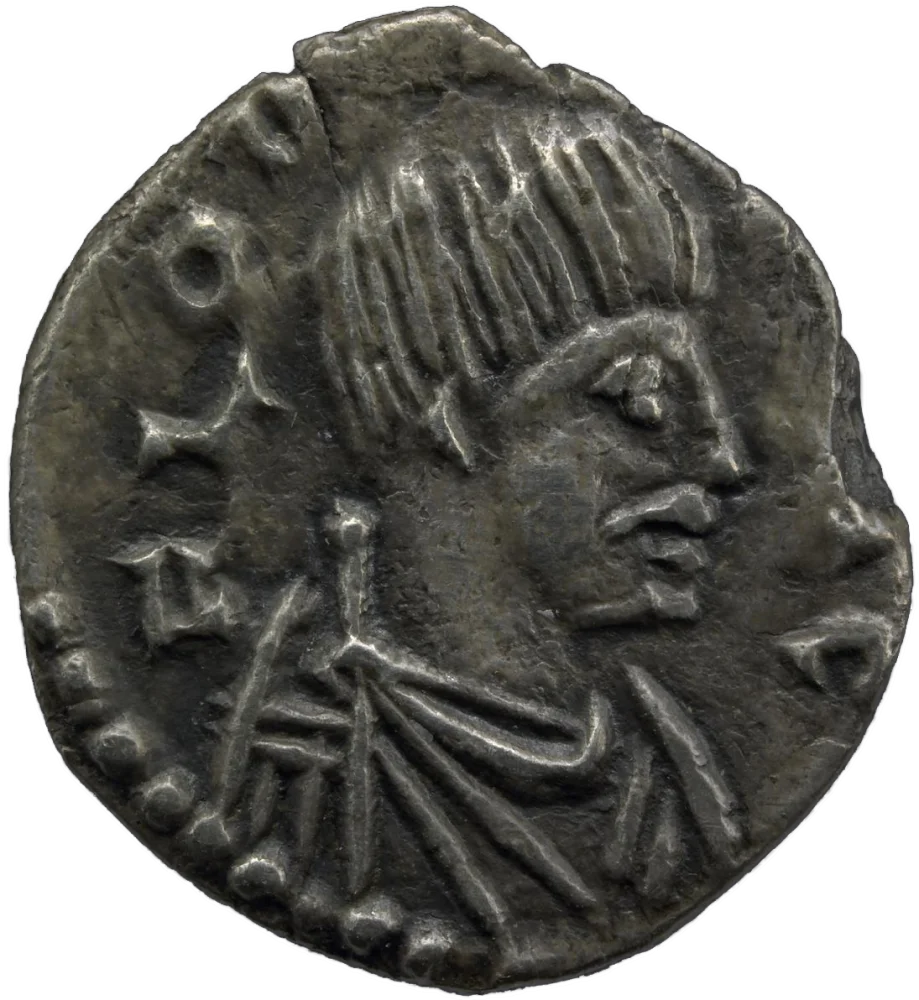
Odoacer
Odoacer came to power in Italy at the moment conventionally used to mark the end of the Western Roman Empire. In 476, the army leader deposed the young ruler Romulus Augustulus and became king in Italy. Yet the change did not erase Roman government: Odoacer worked with the Senate and kept many imperial institutions in place, ruling a Roman population through a military regime that was new in form but strongly connected to the old order.
A Soldier in the Late Empire
Odoacer was born in the middle of the fifth century, probably around 433 or 434. His exact origins are uncertain; ancient accounts associate him with Germanic peoples who served Rome as soldiers. Like many commanders of the period, he built his authority within the Roman military system, where armies could elevate generals as emperors and challenge them when their interests were threatened.
The western empire had already been weakened by repeated civil wars and the loss of territory. In 475, Julius Nepos was driven from Italy by the general Orestes, who placed his young son Romulus on the throne. Nepos continued to claim the imperial title from Dalmatia and was still recognized by the Eastern emperor Zeno.
Orestes promised land in Italy to the soldiers serving under him, but the settlement was not fulfilled to their satisfaction. In 476, Odoacer led the troops in revolt. His forces defeated Orestes, who was captured and executed, and killed Orestes’ brother Paulus. Romulus Augustulus was deposed and sent into retirement near Naples. Odoacer did not appoint another western emperor in Italy.
Ruler of Italy
The Roman Senate sent the imperial insignia to Constantinople, signaling that it no longer needed a separate emperor based in the West. Odoacer ruled as king in Italy while seeking a workable relationship with the Eastern court. Zeno’s response was complicated: the emperor did not simply declare Odoacer a sovereign equal, and continued to recognize Julius Nepos as the legitimate western ruler until Nepos’ death in 480.
In practice, Odoacer controlled Italy. He retained the Roman Senate, kept much of the existing civil administration, and relied on Roman officials to govern provinces and collect taxes. He also commanded a military establishment that depended heavily on non-Roman soldiers. His authority blended Roman offices and practices with the kingship of a military leader.
Odoacer extended his power beyond the Italian peninsula. After Nepos was murdered in 480, he took control of Dalmatia. He also campaigned against the Rugians, defeating them in 487–488 and bringing survivors into the empire. During his rule, the Vandals surrendered their claims to Sicily. These campaigns secured strategic territories and strengthened his position as the dominant ruler in the western Mediterranean.
Theodoric’s Invasion
Odoacer’s arrangement with Constantinople did not last. In 488, Zeno sent Theodoric, leader of the Ostrogoths, into Italy. The emperor may have been trying to remove a rival and redirect Gothic pressure away from the Eastern Empire. Theodoric’s invasion became a long war. Odoacer fought him at the Isonzo and Verona, but after repeated setbacks he retreated to Ravenna, a fortified city protected by marshes and waterways.
The siege of Ravenna lasted for years. In early 493, the two leaders agreed to share rule in Italy, a settlement negotiated by the bishop of Ravenna. The agreement did not hold. Soon after Theodoric entered the city, he killed Odoacer, reportedly at a banquet arranged as a reconciliation. Theodoric then took control of the kingdom.
The End of a Western Court
Odoacer ruled for nearly 17 years. His deposition of Romulus Augustulus became a symbolic turning point, but the end of imperial government in the West was gradual rather than a single dramatic collapse. Julius Nepos continued to claim the western throne for several years, and Roman law, offices, taxation, and the Senate endured under Odoacer.
His rule showed how political power had shifted toward military leaders who could command loyalty from the army and negotiate with the eastern court. Odoacer was neither simply a Roman emperor nor an outsider who swept away Roman life. He was a new kind of ruler in a transformed empire: a king whose power depended on troops, yet whose government relied on many of Rome’s institutions.
The event that made Odoacer famous was also the beginning of his vulnerability. He ended the western imperial court in Italy, but his authority remained tied to the same military politics that had brought him to power. Theodoric’s invasion and betrayal ended his reign, leaving Odoacer as the first of the post-imperial kings who would rule Italy.


