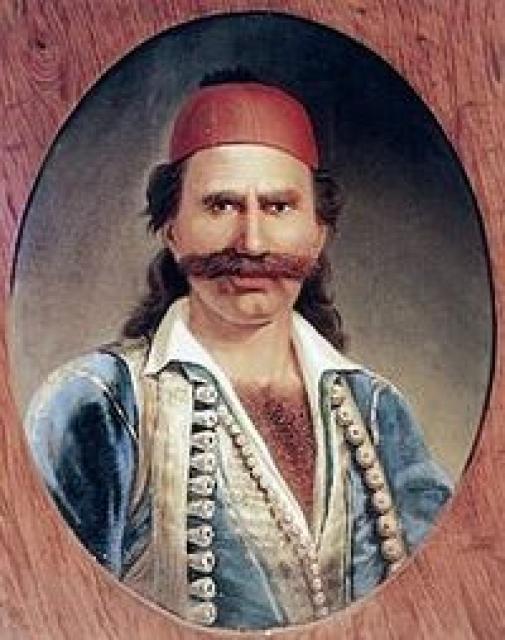
Odysseas Androutsos
 Greece
- Odyssey Androutsos: Greek Revolutionary Hero
- Education and Influence
- Military Prowess and Character
- Early Victories and Intrigue
- Conflict with the Government and Exile
- Loss of Command and Political Persecution
Odyssey Androutsos: Greek Revolutionary Hero
Early Life and FamilyOdyssey Androutsos, born in 1790 on the island of Ithaca, was the son of the legendary klepht (mountain bandit) Andreas Androutsos and a woman from Preveza. His father joined the pirate fleet of Lampros Katsonis, a Greek insurgent and Russian officer, after decades of fighting against the Turks. Katsonis became Odyssey's godfather.
Education and Influence
Following his father's imprisonment and execution, Odyssey grew up at the court of Ali Pasha, his father's old friend. There, he received an education and became one of the most literate Greek commanders. Odyssey's passion for "history and antiquities" is evident in his 1823 letter to Adamantios Korais, urging him to return to Greece amidst the revolution.
Military Prowess and Character
When the Greek Revolution broke out in 1821, Odyssey, then 31, had already established a heroic reputation. Known for his pride, determination, and swift decision-making, he was feared by Albanians and Turks alike. George Karaiskakis, a fellow commander, described him as "the only strategist" in the Greek forces, praising his exceptional intellect.
Early Victories and Intrigue
Odyssey participated in the secret meeting that initiated the uprising on Lefkas. He launched the first military operations in western Central Greece, eliminating Hasan Bey and his 60 gendarmes. With 116 companions, Odyssey fought a glorious battle in Gravia.
However, by 1822, Odyssey's prominence attracted the envy of landowners and politicians, particularly Alexandros Mavrokordatos. Mavrokordatos, who aligned Greece with Britain, resented both uneducated commanders and those who stood out, like Odyssey.
Conflict with the Government and Exile
Odyssey resigned his command in April 1822. In May, he killed two government envoys who attempted to arrest him. The government declared him an outlaw and offered a reward for his capture. Despite being a fugitive, Odyssey remained focused on the war.
In July, he disrupted supply routes from Lamia to Corinth. In August, he entered Athens, where he was proclaimed commander of eastern Central Greece despite his fugitive status.
Loss of Command and Political Persecution
In March 1823, the National Congress dissolved the military commands of Peloponnese and Central Greece to weaken the commanders' power. Odyssey urged the democratic faction to challenge the oligarchs, but Dimitris Ypsilantis intervened.
Odyssey's conflicts with the government continued until his assassination in 1825 in an ambush orchestrated by his rivals. Despite his tragic ending, Odyssey Androutsos remains a legendary figure in Greek history, embodying the ideals of national liberation and resistance to oppression.


