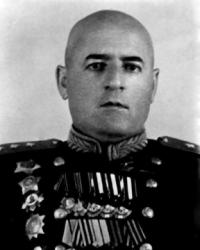
Georgiy Goncharenko
- Early Life and Military Career
- Military Leadership and Literary Contributions
- World War I and the Bolshevik Revolution
- Civil War and Exile
- Final Days and Legacy
Early Life and Military Career
Nikolay Alexandrovich Krasnov was a prominent Russian general, author, and poet. Born into the family of an inspector of secondary educational institutions, he exhibited exceptional academic prowess from a young age. Krasnov graduated from the Polotsk Cadet Corps with distinction and embarked on a military career in 1895.
Following his graduation from the Nikolaev Cavalry School in 1897, he joined the prestigious Leib-Guard Cuirassier Regiment of Her Majesty. His military acumen and dedication were recognized early on, as he was entrusted with various important positions within the Russian army.
Military Leadership and Literary Contributions
In 1900, Krasnov was admitted to the Nikolaev Academy of the General Staff, completing his studies in 1903. His exceptional academic performance earned him the rank of Staff Captain and transfer to the General Staff headquarters. Throughout his military career, he held various command positions, including Senior Adjutant of the 18th Infantry Division and Chief of Staff of the Ust-Dvina Fortress.
Krasnov's literary talents emerged early in his life. In 1907, he published his first poetry collection, "Evening Lights." He also actively contributed to military journals and newspapers throughout his career.
World War I and the Bolshevik Revolution
During World War I, Krasnov served as Commander of the 19th Dragoon Arkhangelgorodsky Regiment. He distinguished himself in combat for leading a daring cavalry charge against overwhelming enemy forces. For his bravery, he was awarded the prestigious George's Weapon in 1917.
Following the Bolshevik Revolution in October 1917, Krasnov remained in service within the Red Army. However, his political views brought him into conflict with the new regime. He was dismissed from the military in 1918.
Civil War and Exile
In 1919, Krasnov joined the forces of the White Army in the Russian Civil War. He fought against the Bolsheviks in the South of Russia and later in the Far East. After the defeat of the White Army, he was forced to flee to China.
In 1923, Krasnov returned to Riga, Latvia, where he worked as a cavalry instructor at the Military School and as a judge at the hippodrome. He also contributed to several newspapers and magazines, becoming a renowned author in exile.
Final Days and Legacy
Krasnov's life came to a tragic end in 1940 when he was summoned by the Soviet secret police (NKVD) and subsequently committed suicide. He was buried in the Pokrovsky Cemetery in Riga.
Despite the circumstances of his death, Krasnov's literary and military contributions remain a significant part of Russian history. His writings, particularly his military memoirs, provide valuable insights into the turbulent era of the early twentieth century.