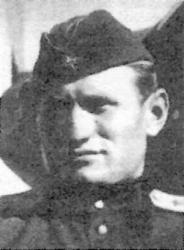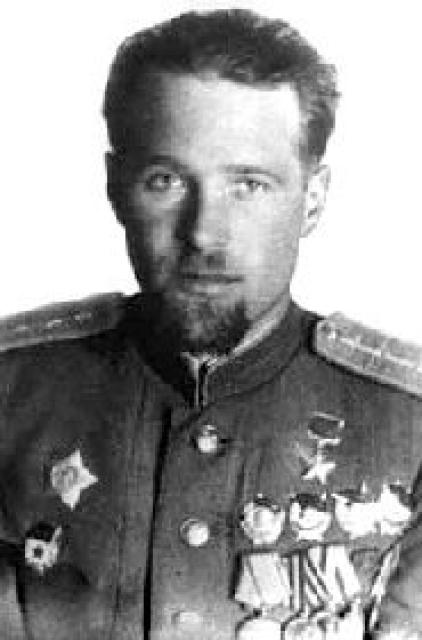
Oleg Belikov
 Ukraine
Biography of Oleg Belikov
Oleg Stepanovich Belikov was born on August 22, 1918, in the village of Klachka, which is now within the city of Dnepropetrovsk. He came from a working-class family. Belikov completed 7 grades of primary school and then attended a vocational school. After that, he worked at the Artem factory. In 1937, he joined the Red Army. In 1939, he graduated from the Kachinsk Military Aviation School for Pilots.
At the start of the Great Patriotic War, Belikov served in the active army. By August 1944, he became the commander of the 19th Separate Fighter Aviation Regiment, part of the 16th Air Army and the 1st Belorussian Front. Belikov flew 635 successful combat sorties, took part in 114 aerial battles, personally shooting down 15 enemy aircraft and 14 more as part of a group. He was severely wounded in one of the battles. On August 19, 1944, for his courage and bravery in combat, he was awarded the title of Hero of the Soviet Union.
After the war, Belikov retired and lived in the city of Kharkov. He was decorated with the Orders of Lenin, the Red Banner (thrice), Suvorov 3rd class, and various medals. He passed away on February 28, 1982.
Passion for Aviation
Like many other young men of the pre-war period, Oleg Belikov developed a passion for aviation through his involvement in an aeroclub. He then attended a military aviation school for pilots...
During the Great Patriotic War, he served as the commander of the 19th Fighter Aviation Regiment. By that time, Belikov had mastered the art of aerial combat and had become one of the best pilots in the regiment. His squadron fought fiercely against the enemy, providing air cover for tank and motorized units of General Kleist's tank group, which was advancing southeast. They also participated in the battles for the "gates" of the Caucasus, such as the city of Rostov-on-Don, and launched attacks on enemy tank columns in the areas of Armavir and Nevinnomyssk. On April 5, 1942, a group of fighters led by Belikov launched an attack on a large enemy column of tanks, vehicles, and troops on the Slavyanok-Raigorodka road. In the aerial battle, they shot down 4 enemy fighters.
In July, Belikov's squadron engaged in battle with 30 enemy bombers attempting to break through to Rostov-on-Don. Caught off guard, the German pilots, in their haste to escape, were forced to drop bombs on their own troops. In this battle, our pilots destroyed 6 enemy aircraft. In February 1943, while on a reconnaissance mission, Belikov discovered an enemy airfield with about 70 planes. After gathering intelligence, he volunteered to lead a strike group of our IL-2 attack aircraft to attack the enemy airfield. During this operation, Belikov shot down one Messerschmitt, and our attack aircraft completely destroyed the enemy airfield along with the planes stationed there.
Over the course of 9 months of combat, Oleg Stepanovich was twice awarded the Order of the Red Banner. In early July 1943, Belikov's squadron played an active role in blocking an enemy airfield near Belgorod and supported the massive strikes by our attack and bomber aviation against it. They engaged in combat with up to 30 enemy fighters who failed to break through to our attack group. In the same area, Belikov's unit engaged in an unequal fight with 28 enemy fighters. The battle lasted for over half an hour, during which Belikov personally shot down 4 enemy fighters. For his exemplary execution of combat missions in the Belgorod area, the brave warrior was awarded the third Order of the Red Banner.
In May 1944, Oleg Stepanovich received an order to fly as part of a group of six La-5 fighters on a "free hunt" in the Gorodenka area. While flying at an altitude of 5,000 meters, he received a radio order from the regiment commander to intercept a group of enemy bombers in the Korcheva area. Upon approaching the combat zone, Belikov spotted 9 Ju-87 bombers and launched a surprise attack on them. He shot down three of them on the first pass. The remaining bombers, dropping their bombs haphazardly, tried to escape. Belikov, engaging two enemy cover fighters, pursued the enemy. Along the way, the fearless quartet encountered a second group of Junkers, which had relieved the first group, and attacked them. As a result of the fierce battle, 6 enemy dive bombers were shot down. One of them was personally shot down by Belikov.
Among the fighters, the 176th Fighter Aviation Regiment stood out for their excellent results in combat. In August 1944, they engaged in 13 aerial battles, shooting down 15 FW-190 aircraft without any losses of their own. The pilots of the 30th and 67th Guards Fighter Aviation Regiments, as well as the 19th Fighter Aviation Regiment, also fought admirably against the enemy in the "free hunt". Major Heroes of the Soviet Union A. Ya. Baklan and D. S. Titorenko, Senior Lieutenants M. F. Tarakanov and A. A. Karaev, Captains O. S. Belikov and M. N. Tyulkin, and Lieutenant V. A. Gromakovski distinguished themselves in their execution of combat missions. On August 19, 1944, for their courage and bravery in battle, Oleg Stepanovich Belikov was awarded the title of Hero of the Soviet Union.
On January 17, 1945, the fighter aviation units of the 16th Air Army not only fought successfully against the enemy in the air but also actively carried out ground attack missions. On this day, 147 fighters took off with bombs, and around 300 vehicles and other military equipment were destroyed or damaged. Groups from the 176th Guards Fighter Aviation Regiment, led by Hero of the Soviet Union Captain O. S. Belikov and Senior Lieutenant N. S. Rudenko, engaged in a "free hunt" and attacked the Lovich airfield, destroying 6 enemy aircraft.
Belikov ended the war as part of the 176th Guards Proskurov Fighter Aviation Regiment, having mastered the I-16, LaGG-3, La-5, and La-7 aircraft by that time. According to some sources, he personally shot down 21 enemy aircraft and 14 more as part of a group.
During the war, the pilots of the 176th Guards Proskurov Fighter Aviation Regiment conducted 8,535 combat sorties, engaged in 711 aerial battles, shot down 398 enemy aircraft, and destroyed another 56 on the ground. Through their ground attack actions, they destroyed 3 tanks, 256 vehicles, 213 carts, 7 fuel trucks, and 7 anti-aircraft batteries. They also disabled 36 locomotives and 1 train. Ten pilots achieved more than 15 victories each in aerial combat. The unit suffered 48 losses among pilots and 104 losses of aircraft in combat, as well as 5 losses of pilots and 15 losses of aircraft due to non-combat reasons.
The famous 176th Guards Fighter Aviation Regiment was succeeded by the 237th Guards Proskurov Red Banner Order of Kutuzov and Order of Alexander Nevsky Center for Aviation Technology Demonstration named after I. N. Kozhedub, located at the Kubinka airbase near Moscow.
Soon after the end of the war, Oleg Stepanovich retired from active duty. He lived in the city of Kharkov.