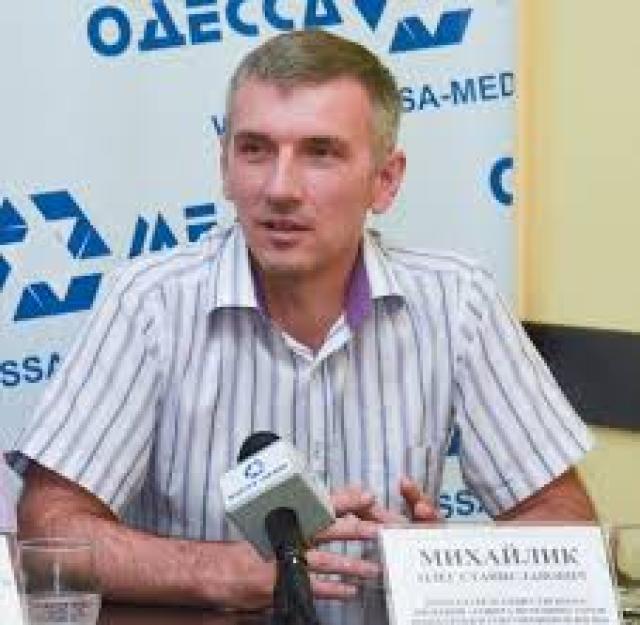
Oleg Mikhailik
 Ukraine
- A career that began at sea
- A civic voice in Odesa
- A shooting that drew national attention
- From recovery to public service
Oleg Mikhailik is a Ukrainian journalist and civic activist whose work in Odesa has focused on local accountability, urban development and residents’ rights. Trained as a marine engineer, he spent years at sea before becoming a television host and community organizer. His public profile grew through campaigns over unfinished housing projects and the preservation of Odesa’s historic spaces; in 2018, he survived a near-fatal shooting that drew national attention to the dangers faced by activists.
A career that began at sea
Born on December 5, 1974, Mikhailik trained in marine engineering at Odesa’s maritime college, graduating with honors in 1994. He continued his studies at Odesa State Maritime Academy, completing a degree in ship power systems in 2002, and later earned a manager-economist qualification from Odesa National Maritime University in 2005.
From 1994 to 2010, he worked in the civil maritime fleet, moving into senior engineering work aboard offshore support vessels. He finished his seafaring career as chief engineer on a vessel supporting underwater technical operations in oil and gas fields. The technical background gave him first-hand experience with complex workplaces and infrastructure, but his next chapter took shape on land, in the city where he had studied and built his life.
A civic voice in Odesa
Mikhailik began participating in campaigns against what residents and activists described as illegal construction in Odesa in 2013. He became involved in efforts to protect architectural heritage, public spaces and coastal areas, and in advocacy for investors who had paid for apartments in unfinished developments. He later led the civic organization Prave Dilo, which worked on housing and investor protections.
He also entered party politics, joining the Silʹ Liudei party in 2015 and becoming head of its Odesa city organization the following year. Alongside this work, he helped establish a school of local self-government, aimed at equipping citizens and community activists with knowledge about how municipalities function. From 2017, he hosted weekly live programs on Odesa’s Channel 7, giving him a regular platform to discuss local affairs.
A shooting that drew national attention
On September 22, 2018, Mikhailik was shot near his home in central Odesa. The bullet passed through his arm and lodged in his lung. He lost a large amount of blood and experienced clinical death, but survived. At the time, his colleagues and supporters linked the attack to his public work and criticism of local development and government; responsibility and motive were not conclusively established.
In January 2019, he underwent a complicated operation in Munich to remove the bullet and part of his lung. The attack became part of a wider debate in Ukraine about violence against journalists and civic activists and the authorities’ ability to investigate such cases. In 2024, the European Court of Human Rights ruled that the investigation into the attack had not been effective, finding a violation of the right-to-life provision’s procedural requirements. The attackers’ full responsibility and any alleged organizers remained unresolved in public reporting.
From recovery to public service
Mikhailik returned to public life after recovering from his injuries. He remained involved in Odesa civic initiatives and continued speaking publicly about the investigation and local governance. He has also taken on organizational roles in community and reform projects, including leading a regional branch of the Office of Simple Solutions and Results.
His story is defined by a change in direction: from maritime engineering to journalism and civic activism, and by the persistence with which he returned to public work after a life-threatening attack. In Odesa, he became known as a voice for residents challenging developments they believed threatened their homes, heritage and shared spaces.