Oles Byzina
 Ukraine
- Biography of Oles Buzina
- Public Views
- Incidents
- Assassination
- Investigation
- Memorial
- A poem dedicated to Buzina was written by Yuna Moritz.
Biography of Oles Buzina
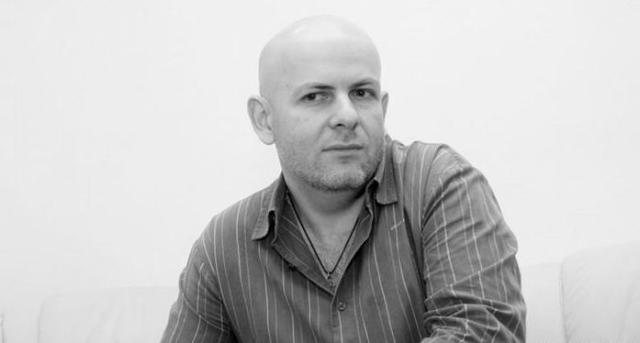
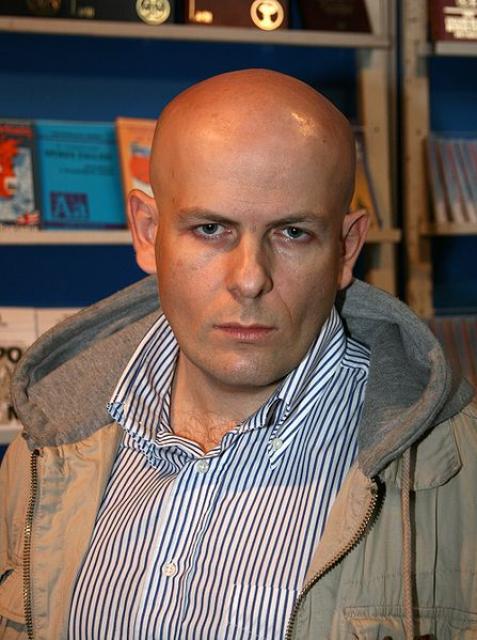
Oles Alexeyevich Buzina was a contemporary Ukrainian writer, journalist, and television presenter who wrote in both Ukrainian and Russian. He was born on July 13, 1969, in Kyiv. According to his own words, Buzina's parents were descendants of Ukrainian Cossacks and peasants. His father, Alexey Grigoryevich Buzina, was an officer of the 5th (ideological) department of the KGB. The writer's great-grandfather served as an officer in the Tsarist army and was sent to work on the construction of the White Sea-Baltic Canal during the collectivization of the 1930s.

Buzina studied at Kyiv Specialized School No. 82 named after T.G. Shevchenko. In 1992, he graduated from the Philological Faculty of Kyiv National University named after Taras Shevchenko, specializing in "Russian language and literature." However, he did not pursue a career in teaching. Buzina worked for various Kyiv publications, including the newspapers "Kyivski Vedomosti" (1993-2005) and "2000" (2005-2006), as well as the magazines "Drug Chitatelya," "Lider," "Natali," "Ego," and "XXL." Since 2007, he had a regular column and blog in the newspaper "Segodnya." In October 2006, he hosted the program "Teen-liga" on the "Inter" channel, a modern Ukrainian version of the game "Brain-Ring." From 2010 to 2011, he collaborated with journalist Yevgeny Morin on the series of documentary films "In the Footsteps of Ancestors." Since 2011, he participated in the program "The Bachelor. How to Get Married?" with Anfisa Chekhova. He ran as a candidate for the Ukrainian Parliament in the majoritarian Kiev city electoral district No. 223 representing the "Russian Bloc" party and placed fourth, receiving 8.22% of the votes. In the repeat elections for the same district on December 15, 2013, Buzina received 3.11% of the votes. Since January 2015, he was the editor-in-chief of the newspaper "Segodnya." In March 2015, he resigned, citing censorship from the management of the "Media Group Ukraine" information holding, which prohibited criticism of Prime Minister Arseniy Yatsenyuk and former President Leonid Kuchma. Buzina also mentioned the lack of clear authority as editor-in-chief, the lack of control over the newspaper's website, and the ban on participating in talk shows and giving interviews to the media. Oles Buzina was repeatedly invited to talk shows on Russian television, and his articles and interviews were published in Russian media.
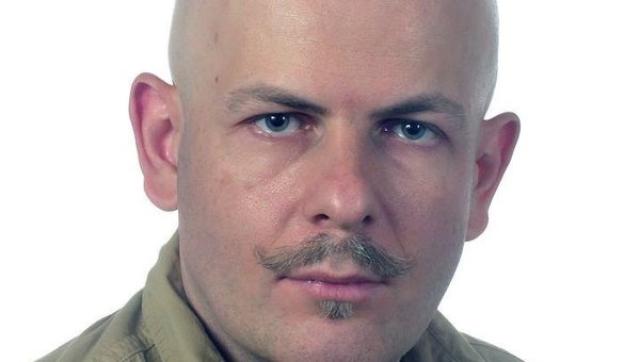
Oles Alexeyevich Buzina was killed on April 16, 2015. The funeral took place at the Kyiv-Pechersk Lavra Cathedral. He was buried on April 19, 2015, at the Berkovetsky Cemetery in Kyiv. Oles Buzina was laid to rest amidst applause.

Public Views
Oles Buzina believed in the unity of the Russian people, referring to them as "malorossy, belorussy, and velikorossy," which is why he identified himself as both Ukrainian and Russian. He supported the federalization of Ukraine, its independence, and bilingualism in Ukrainian culture, advocating for the extensive development of both the Ukrainian and Russian languages. According to him, "conscious Ukrainians are more concerned with the destruction of Russian culture than the creation of Ukrainian culture." Oles Buzina never supported the "Orange Revolution" and founded the movement of so-called "Shevchenkophobes."
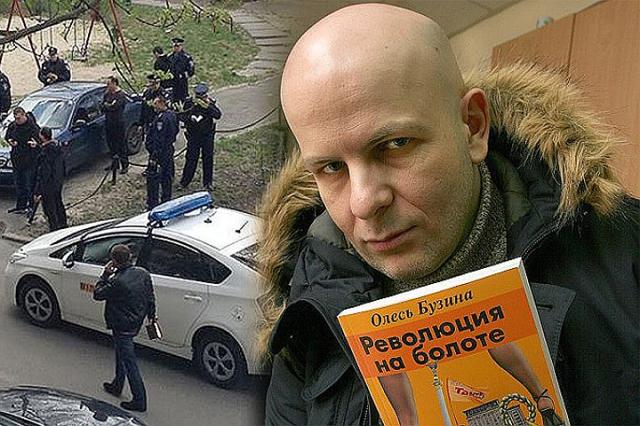
After the publication of his book "Vurdalak Taras Shevchenko," the National Union of Writers of Ukraine asked the prosecutor's office to initiate a criminal case against Oles Buzina for inciting interethnic hostility and defamation against Shevchenko. After the prosecutor's office refused to initiate the case, the Union of Writers of Ukraine turned to the court, but the writer won the lawsuit, proving the groundlessness of the accusations. Following the unsuccessful litigation initiated by the Union of Writers of Ukraine, an attack on the writer took place right outside the courthouse. Buzina was the subject of 11 lawsuits, all of which he won. The initiators of the lawsuits against Buzina were also politicians Pavel Movchan (head of the "Prosvita" society) and Volodymyr Yavorivsky (Bloc Yulia Tymoshenko).
In January 2006, Oles Buzina stated that, as a writer, he was aware of the existence of political censorship in Ukraine (associated with the regime established after the "Orange Revolution") because several Ukrainian publishers were afraid to publish his books.
In May 2009, Oles Buzina proposed a package of laws banning neo-Nazi organizations and the propaganda of Nazism, as well as prohibiting the propaganda of the ideological heritage of the Organization of Ukrainian Nationalists as a totalitarian fascist party. This proposal was supported by one of the leaders of the Party of Regions, Boris Kolesnikov. According to Oles Buzina, as published on the anti-Yushchenko website "Antifascist Committee of Ukraine," Ukrainian President Viktor Yushchenko patronized Ukrainian neo-Nazism and was himself a neo-Nazi.
Oles Buzina was subject to attempts of ideological censorship. In May 2009, the National Expert Commission of Ukraine for the Protection of Public Morality instructed its staff to monitor print media for compliance with the law "On the Protection of Public Morality." This was done at the initiative of commission member, director of the Institute of Ukrainian Studies, P. Kononenko, who drew the commission's attention to Oles Buzina's publications in the newspaper "Segodnya," claiming that they "discredit prominent Ukrainian figures and highlight everything shameful in our history."
The "Gay Forum of Ukraine" in 2011 ranked him fourth in the rating of "Homophobic Activist of the Year." In particular, the writer made the following statement about homosexuals: "They should respect my physical disgust towards them and try not to exhibit their depraved inclinations in my presence. Moreover, they should not impose them on society. The place for pedophiles is among pedophiles."
Incidents
On March 11, 2011, during the live broadcast of the talk show "Big Politics" hosted by Yevgeny Kiselyov, Sergei Poyarkov read a flattering review of Buzina's article about Poyarkov as an artist and writer, claiming that he had paid Buzina for the article. The verbal altercation escalated into a fight, after which Buzina was removed from the studio. Kiselyov explained that it was not because he started a fight but because he dared to accuse Kiselyov of inviting someone to the program for money. There were speculations that the fight was planned, but the participants denied this.
Assassination
In March 2015, a month before his death, Buzina spoke in an interview with the "Russian Newspaper" about attacks and threats against him. Concerns about his life were also expressed on several television shows (including Vladimir Solovyov's program on January 30, 2014).
Oles Buzina was shot with a TT pistol on April 16, 2015, around 13:20 in Kyiv, near his home on Degtaryovskaya Street, 58. According to the Ministry of Internal Affairs, the killers were two unknown individuals wearing masks. A car with Italian license plates was later found abandoned in the Shevchenkivsky District of Kyiv. No evidence indicating the identity of the criminals was found in the car.
According to an email sent, the "Ukrainian Insurgent Army" took responsibility for the murder (as well as for the murder of Oleg Kalashnikov). An organization with this name is included in the list of extremist organizations in Russia, but Ukrainian law enforcement agencies deny its existence. Representatives of the Security Service of Ukraine stated that linguistic expertise showed that the authors of the email were not native Ukrainian speakers.
Journalist Anatoly Shariy and several media outlets pointed out that Buzina's personal information, including his address in Kyiv, was posted on the "Peacemaker" website the day before his murder. The website authors claim that Buzina's information was added to the site after his assassination.
The police consider the murder to be a contract killing related to the journalist's professional activities. Similarities to the murder of Oleg Kalashnikov were noted. Additionally, the investigation is considering the possibility of personal animosity linked to the publication of Buzina's home address in an open-access manner. Among other theories, representatives of the Ministry of Internal Affairs, Ukrainian authorities, and Ukrainian politicians mention provocation from Russian special services, conflicts within the opposition, or revenge from criminal elements allegedly associated with Buzina. However, outside Ukraine (particularly representatives of the Russian government and the Italian publication La Repubblica), opinions were expressed about the political nature of the murder, which is part of a campaign to eliminate political opposition.
The assassination of Oles Buzina received significant attention from top government officials and representatives of international organizations. Ukrainian President Petro Poroshenko called the murder a "provocation" aimed at destabilizing the situation in the country. He personally took control of the investigation. The assassination was condemned, and condolences were expressed to the victim's family, along with demands for a thorough investigation, by UN Secretary-General Ban Ki-moon, official representatives of the OSCE, the United States, and Russia. Journalistic organizations (including Reporters Without Borders and the Committee to Protect Journalists) and human rights organizations (HRW, UNESCO) also called for a thorough investigation and condemned the killing.
Investigation
On June 18, 2015, Arsen Avakov announced the solving of the murder and the arrest of three people accused of the crime. All the detained individuals were activists of the far-right movement. One of the detainees, Andrey Medvedko (known as "Manson"), was an active participant in the Maidan protests and also the leader of the Pechersk District organization of the All-Ukrainian Union "Freedom" in Kyiv. He was an activist and one of the creators of its most radical wing, the organization "C14." In late 2014, Medvedko briefly served in the Anti-Terrorist Operation (ATO) zone as part of the Ministry of Internal Affairs' "Kyiv-2" battalion. The other suspect, Denis Polishchuk (with the nickname "Allah"), was also a nationalist and a participant in the war in Donbas. He ran for the Verkhovna Rada in 2012 as a candidate from the Ukrainian National Assembly political party. The third suspect was released due to lack of evidence. On June 23, Polishchuk was released from custody with round-the-clock house arrest after his bail of 5 million hryvnias was paid by businessman and former deputy chairman of the board of Naftogaz, Alexey Tamrazov. However, on July 2, the court overturned this decision and re-arrested Polishchuk.
On December 9, 2015, the Pechersky District Court of Kyiv released Denis Polishchuk, an activist of a nationalist organization suspected of killing journalist Oles Buzina, from custody and placed him under house arrest with an electronic surveillance bracelet. The measure of restraint was imposed until February 9, 2016. On December 31, Medvedko was also released under house arrest.
On March 25, 2016, the Pechersky District Court of Kyiv refused to extend the house arrest for Denis Polishchuk and replaced the preventive measure with personal recognizance. For Andrey Medvedko, the court replaced the measure of house arrest with personal recognizance.
In May 2016, Buzina's mother reported that Ukrainian authorities did not want to punish her son's killers: the investigation into the case was suspended, and the suspects were released from custody. Subsequently, all measures of restraint against one of the suspects were lifted, and all restrictions on their freedom were removed. On May 23, 2016, the Pechersky District Court of Kyiv refused to extend the personal recognizance measure for Andrey Medvedko, who was a suspect in the murder of Oles Buzina.
Memorial
Memorial events in honor of Buzina took place on April 19, 2015, in Moscow near the Ukrainian Embassy, in Kyiv, and in Luhansk. Several hundred people participated in each of the events.
A poem dedicated to Buzina was written by Yuna Moritz.
On July 13, 2015, a memorial plaque was installed in Kyiv on the house at Degtaryovska Street, 58, where Buzina lived. However, on July 14, three Ukrainian journalists removed the plaque, claiming it was illegally installed. The Russian Ministry of Foreign Affairs condemned the removal of the plaque.
The International Literary-Media Award bears the name of Oles Buzina. It is awarded for achievements in the field of literature and journalism, as well as for public activities related to the history of Ukraine and Russia and contemporary events in both countries.
Fundraising is underway for a monument to Oles Buzina. The monument will be created by the People's Artist of Russia sculptor Andrei Kovalchuk.