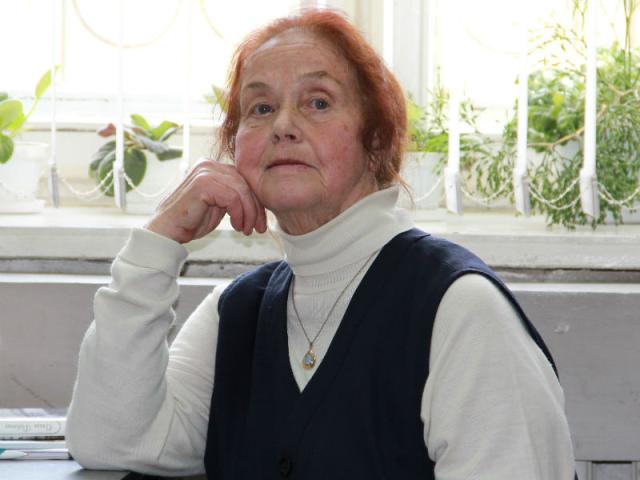
Olga Fokina
 Russia
Soviet Russian poetess
Olga Fokina, a Soviet Russian poetess, is known for her remarkable collection of poetry. If only one poem, "My Bright Little Star," had survived from Fokina's poetic legacy, it would have been enough to cement her place in the Russian poetic classics. However, Fokina's inheritance includes 23 poetry collections that intertwine folk traditions with the sophistication of the Silver Age. Many of Fokina's poems have been set to music and became beloved songs for several generations.

Early life
Olga Fokina was born on September 2, 1937, in the village of Artemyevskaya (now Timoshinskoye), in the Arkhangelsk Region of Russia. The traditions of northern peasants were preserved in this region, instilling in Fokina not only a strong work ethic but also a love for traditional folk songs. Her mother, who had only completed four grades of a church-parish school, knew many poems by heart from Russian classical poets, which she recited to her children in the evenings. Fokina considers the rural holidays and the performance of ancient songs as her poetic school.
Military childhood
Growing up during wartime was not easy for Fokina. Her father returned from the war in 1943, having been conscripted despite having tuberculosis, and he lived only a short time after his return. The family, consisting of six children, suffered from hunger, resorting to eating grass and potato peels and begging for charity. To this day, the poetess cannot bring herself to throw away even a small piece of dried bread.
Pursuit of poetry
Upon completing seven years of education, Fokina decided to pursue a respected and in-demand profession as a nurse. However, after graduating with honors from a medical school in Arkhangelsk in 1956, she realized that she wanted to dedicate her life to poetry. Instead of enrolling in a medical institute, where she could have been admitted without exams, Fokina chose to continue her studies at the Faculty of Philology at the Arkhangelsk Pedagogical Institute. Her poems had already been published in the newspaper "Severny Komsomolets" ("Northern Komsomolets"), and Fokina went to the local branch of the Writers' Union. However, she was denied a recommendation for admission and was sent to manage a medical station in the forest area of Yagrysh and later in Novoye. On these journeys, Fokina had to walk many kilometers through rough terrain, composing poems along the way and sometimes writing them on mustard seed packets.
Recognition and career
In 1957, Fokina decided to try her luck again and sent her poems to the Gorky Literary Institute in Moscow. To her delight, the poet Viktor Bokov responded and invited her to study in Moscow. The admissions committee was astounded by the poems of the young northerner. The committee secretary even sent her a letter directly asking if she was familiar with the work of Marina Tsvetaeva (whom very few people knew about in 1957). The unsuspecting girl couldn't even pronounce the surname correctly and replied that she knew nothing about "Uveraeva." After being accepted into the institute, Fokina met her fellow students from the Vologda Oblast whose names would later become famous, including N. Rubtsov, V. Belov, and S. Vikulov. Fokina eventually married her classmate A.A. Churbanov, who later wrote the book "Salty Sea". They had two children, a son named Sasha and a daughter named Inga. In 1963, Fokina published her first poetry collection, "Cheese Battle," and became a member of the Writers' Union. After completing her studies, the poetess returned to her native North, specifically Vologda, where she still resides and is an honorary citizen of the city. Olga Alexandrovna worked at the newspaper "Vologodsky Komsomolets" and is currently engaged in creative activities. She received the State Prize of the RSFSR for her collection of poems "Poppy Day" (1976). Among her awards are the medal "For Labor Valour" (1967) and the orders "Badge of Honor" (1981) and "Labor Red Banner" (1984). Fokina's latest collection of poems, "Pendulum" (2013), was awarded the All-Russian Literary Prize "Ladoga".



