
Olga Glaztkih
 Russia
- Olga Glatskikh: A Russian Artistic Gymnast
- Early Retirement and Pursuing Education
- And where do you plan to study?
- Did you consider becoming a sports journalist by any chance?
- The Challenges of Artistic Gymnastics
- Is it more rewarding to receive applause or to win a medal?
- Teamwork in Artistic Gymnastics
- Balancing Education and Training
- Are you an excellent student?
- Do your current teachers know that you are an Olympic champion?
- (Note: The text has been reformatted to fit the given word limit)
Olga Glatskikh: A Russian Artistic Gymnast
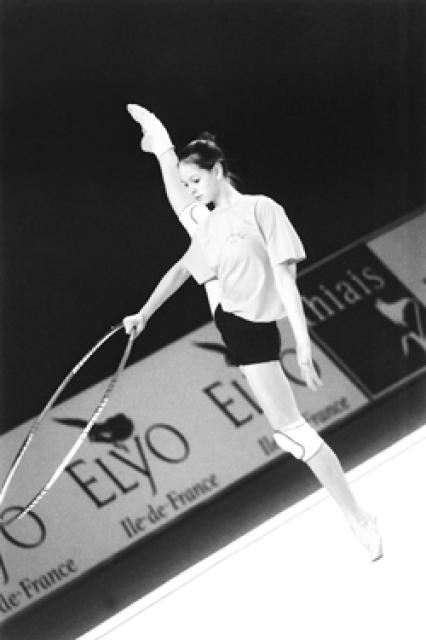
When it comes to stars in modern Russian artistic gymnastics, names like Alina Kabaeva, Irina Chaschina, and Olga Kapranova are usually mentioned. However, not many people are familiar with the girls who perform in group exercises, even though they also bring glory to our sport. One famous group of gymnasts included Olesya Belugina, Tatiana Kurbakova, Elena Posevina, Natalia Lavrova, Elena Murzina, and Olga Glatskikh, who won the Olympic "gold" in Athens. Unfortunately, this group no longer exists. Only Belugina and Posevina continue to perform on the mat, while the other girls have retired from the sport. Olga Glatskikh made this decision at the age of 16, not due to injury or age limitations. The Olympic champion, world champion, and European champion decided to seriously focus on her education. Our correspondent met with the former gymnast Olga Glatskikh.
Early Retirement and Pursuing Education
Olga, it seems strange when an athlete retires at the age of 16, while still in the prime of their physical abilities. Especially since you were the youngest member of the "golden" Olympic team in Athens...
Olga: It's true that athletes don't usually retire from the sport at such a young age. At 16, many are just starting their careers. But I joined the national team when I was only 12. I managed to win the most prestigious titles in artistic gymnastics. In short, I achieved everything I wanted in the sport. I did consider going to Beijing, but I thought and decided to try myself in something else. In any case, sports are not for a lifetime. Sooner or later, I would have had to retire. I chose to retire early, with the aim of having six months to prepare for university. I am currently finishing the 11th grade...
And where do you plan to study?
Olga: At Moscow State University (MGU). I won't reveal the specific faculty yet. Let's just say it's in the humanities.
Did you consider becoming a sports journalist by any chance?
Olga: No, sports have already been a big part of my life. I want to try myself in a different field.
The Challenges of Artistic Gymnastics
Artistic gymnastics, despite its grace, subtlety, and beauty, is quite a demanding sport. The constant training, the strict regimen... Living in such a spartan lifestyle can become tiresome, right?
Olga: Of course, it is not without its challenges. Two four-hour training sessions per day, six times a week. Spectators who only see the competitions don't realize what goes on behind the scenes. Fatigue accumulates, and sometimes you just want to quit... But at the same time, there is a goal that doesn't allow you to give up. There is the concept of a team. You can't let them down or quit halfway. So, you fight with yourself, overcome your limits... And then, when you see that the audience enjoys it, when you yourself get pleasure from it, you understand that there is a reason to work hard.
Is it more rewarding to receive applause or to win a medal?
Olga: Applause is a reward for the performance, while a medal is a reward for all the hard work that led up to it.
Teamwork in Artistic Gymnastics
All the accolades seem to go to the girls who compete individually. However, I assume that team coordination requires even more thorough preparation. You must train more, right?
Olga: Yes, it is easier to structure the training process for an individual gymnast. Some may only need to work in the gym for an hour, while others may need five hours. In a group, several people need to be brought to a common denominator. And if someone is struggling, everyone trains. As for the fact that the girls competing individually are more popular... We don't envy their fame. Again, because working and winning as a team is a special pleasure.
By the way, speaking of training, there was recently a case in Omsk where a coach in artistic gymnastics mistreated her athlete...
Olga: Yes, I heard about that story. But I have never encountered such coaches myself. I have never been physically abused. Yes, there were times when coaches shouted, but that's understandable. Sometimes you don't fully grasp what they are saying, you may miss something. Our coaches, considering the amount of time we spend in training camps and competitions, become like second parents to us.
Balancing Education and Training
Is it easier to study or to train?Olga: Physically, of course, studying is easier. Although it's difficult to compare these activities. I enjoy learning.
Are you an excellent student?
Olga: I used to be until the seventh grade. But when I was invited to join the national team and moved to Moscow, I had less time for studying. My grades dropped to four.
Do your current teachers know that you are an Olympic champion?
Olga: They know. But I'm not any different from ordinary students. I am an Olympic champion in artistic gymnastics, not in mathematics. I don't appreciate it when people flaunt their achievements and assert their authority.


