Oskar Schlemmer
 Germany
- Oskar Schlemmer Biography
- Early Work
- Bauhaus Years
- Theater and Teaching Career
- Persecution and Later Years
Oskar Schlemmer Biography
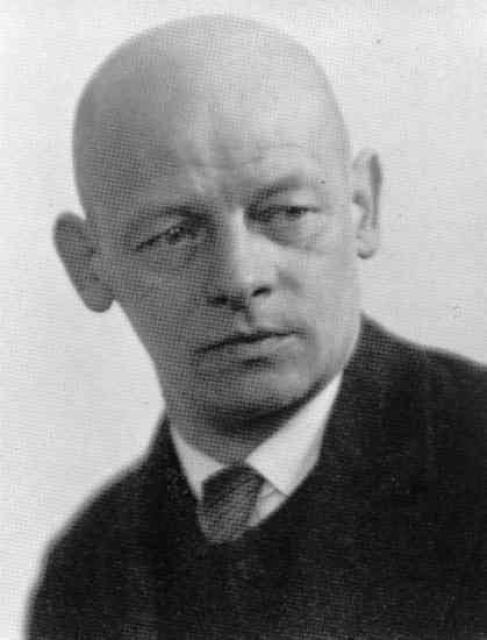
Oskar Schlemmer, a German artist, sculptor, choreographer, and stage designer, was born in 1888. He gained recognition for his diverse artistic styles and contributions to the development of 20th-century art movements.
Early Work
Around 1913, Schlemmer's main focus became the representation of human figures. He depicted these figures in a geometric and abstract manner, creating ornamental patterns on the surface of his paintings. His artistic works encompassed a wide range of styles and movements, including geometric abstraction, cubism, and classicism in portraiture and landscapes.
Bauhaus Years
In 1920, Schlemmer received an invitation to join the Bauhaus in Weimar. He initially led the metalworking workshop and later became the head of the sculpture workshop in 1922. His artistic style was strongly influenced by metaphysical painting (Pittura Metafisica) starting from 1923. During this period, he reduced the number of human figures in his paintings and arranged them within a well-defined choreographic structure, reflecting universal harmony. His works gained recognition and fame after being acquired by the Berlin National Gallery and the Folkwang Museum in Essen.
Theater and Teaching Career
Schlemmer's theatrical set designs and ballet choreography at the Bauhaus also brought him acclaim during this time. From 1929 until its closure in 1932, he served as a professor at the Breslau Academy. However, with the rise of the Nazis in 1933, his contract with the Berlin Unified School of Arts was canceled. This period marked a shift in his artistic style, with smaller formats, figures placed closer together, and softer, more rounded forms depicted using warm and often dark colors.
Persecution and Later Years
In 1937, Schlemmer was forbidden to participate in art exhibitions, and five of his paintings were displayed by the Nazis as examples of "degenerate art." Faced with financial difficulties, he worked as a craftsman in Stuttgart. His final body of work, a series called "Window Pictures," consisted of 18 small watercolor paintings that depicted illuminated windows of neighboring houses.
Oskar Schlemmer passed away in 1943, leaving behind a legacy of innovative artworks that continue to inspire and influence the fields of visual arts, sculpture, choreography, and stage design.