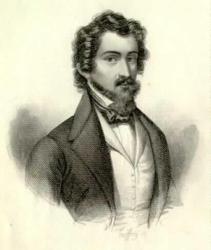
Ovid
 Italy
ItalyBiography of Ovid
Publius Ovidius Naso, better known as Ovid, was one of the most talented Roman poets. He was born in the land of the Peligni, a small tribe in the mountainous region of central Italy. Ovid's precise place and time of birth are revealed in his autobiography (Trist., IV, 10). His family belonged to the equestrian class, and his father, a wealthy man, provided his sons with an excellent education. While attending schools in Rome under famous teachers, Ovid did not feel inclined towards oratory, but rather showed a passion for poetry from an early age. His verses flowed effortlessly, even when he needed to write prose. At his father's request, Ovid entered public service, but he soon gave it up after holding minor positions, preferring to pursue his love for poetry. He married early, as his father wished, but the marriage ended in divorce. His second marriage was brief and unsuccessful, but his third wife, of the Fabian family, remained his companion for life. It is believed that she bore him a daughter named Perilla, who also wrote poetry (Trist., III, 7, 11). Ovid furthered his education through travels to Athens, Asia Minor, and Sicily. Upon his return, he emerged as a prominent figure in the literary scene and gained friendships with notable poets such as Horace and Propertius. Ovid regretted the premature death of his close relationship with Tibullus and his limited interaction with Virgil, who rarely resided in Rome. Ovid's Early Works Ovid's early literary experiments, except for those he burned for revision, included "Heroides" and love elegies. His poetic talent shines through in the "Heroides," but he captured the attention of Roman society with his love elegies, published under the title "Amores." Initially released in five books, Ovid later compiled three books consisting of 49 poems, excluding many works that he himself had included. Based on his personal love affairs, these elegies revolve around the fictionalized persona of his lover, Corinna, whose name reverberated throughout Rome, as Ovid himself claimed (totam cantata per Urbem Corinna). In these somewhat lascivious works, Ovid fully demonstrated his brilliant talent, which had already made his name famous and popular at a young age. Concluding the last of these elegies, he imagines himself having brought as much glory to his native Peligni as Mantua owes to Virgil or Verona to Catullus. Undoubtedly, Ovid's poetic talent, characterized by its freedom, naturalness, wit, and precision of expression, is abundant in these elegies, as is his skill in versification, for which he found no metric difficulties. However, even after the publication of his "Amores," Ovid did not have sufficient grounds to place himself on par with Virgil or even Catullus. He did not surpass Tibullus or Propertius either, from whom, like Catullus himself, he borrowed extensively, even verbatim or almost verbatim (see Zingerle, "Ovidius und sein Verhaltniss zu den Vorgangern und gleichzeitigen Romischeu Dichtern," Innsbruck, 1869-71). Another work that caused a sensation at the time was the one Ovid had announced to his readers in the 18th elegy of the second book, titled "Ars amatoria" ("The Art of Love"). This didactic poem, written in three books, was composed in elegiac verse, like most of Ovid's works. It provided instructions, first for men on how to win and keep a woman's love (books 1 and 2), and then for women on how to attract and maintain men's affection. While the content of this work is often indecent, Ovid's justification that he wrote these instructions only for public women, solis meretricibus (Trist., II, 303), is poorly defended. Nevertheless, the poem's literary value lies in its meticulousness and the masterful hand that meticulously describes one situation after another with brilliance, certainty, and self-control. Ovid composed this work between 2 and 1 BCE, when he was 41-42 years old. Following the publication of the "Ars amatoria," Ovid also released another work in the same vein, of which only a fragment of 100 lines remains. This work is titled "Medicamina faciei" in the manuscripts and editions of Ovid, but in his own writings, he simply refers to it as "Ars." It explores facial care techniques and beauty practices and is mentioned by Ovid in Book III of the "Ars amatoria" (line 205), where he calls it "Medicamina formae" ("Remedies for beauty") and adds that it may be small in size but great in effort and care (parvus, sed cura grande, libellus, opus). The surviving fragment lists the fish of the Black Sea and describes their properties. This work, referred to by Pliny in his "Natural History" (XXXII, 5) for its subject matter, does not possess any remarkable literary qualities. It would have been much more interesting if we had the tragic play "Medea" by Ovid, which was considered one of the best examples of this literary genre in Roman literature. Although it was written during his youth, it was highly regarded in Rome. Quintilian refers to it with pleasure (X, 1, 98), and Tacitus mentions it in his "Dialogus de Oratoribus" (Chapter 12). Several other works written partly in Rome and partly in Tomis are also lost to us. Ovid mentions an encomium to Augustus written in the Getic language in one of his Pontic letters (IV, 13, 19 and following). He still hoped for his situation to be alleviated, if not fully pardoned. However, those hopes were not fulfilled, as neither Augustus nor Tiberius, whom he also appealed to, granted him a return from exile. Ovid's Final Works Instead of these lost works, we have two surviving works that are entirely related to Ovid's time in exile. One of them is called "Ibis," a satire or lampoon against an enemy who continued to pursue his memory in Rome and tried to turn his wife against him after his exile. Ovid sends countless curses to this enemy and threatens to expose his name in another work, which he will write in iambic verse rather than elegiac, meaning with all the epigrammatic acidity. The title and form of the work were borrowed from the Alexandrian poet Callimachus, who wrote something similar against Apollonius of Rhodes. The other surviving work, unrelated to the rest, is a didactic poem on fishing called "Halieutica." We only have a fragment in which the fish of the Black Sea are listed along with their properties. This work, referred to by Pliny in his "Natural History" (XXXII, 5), does not possess any remarkable literary qualities. It would have been much more interesting if we had the tragic play "Medea" by Ovid, which was considered one of the best examples of this literary genre in Roman literature. Although it was written during his youth, it was highly regarded in Rome. Quintilian refers to it with pleasure (X, 1, 98), and Tacitus mentions it in his "Dialogus de Oratoribus" (Chapter 12). Several other works written partly in Rome and partly in Tomis are also lost to us. Ovid mentions an encomium to Augustus written in the Getic language in one of his Pontic letters (IV, 13, 19 and following). He still hoped for his situation to be alleviated, if not fully pardoned. However, those hopes were not fulfilled, as neither Augustus nor Tiberius, whom he also appealed to, granted him a return from exile. Ovid's Final Works Instead of these lost works, we have two surviving works that are entirely related to Ovid's time in exile. One of them is called "Ibis," a satire or lampoon against an enemy who continued to pursue his memory in Rome and tried to turn his wife against him after his exile. Ovid sends countless curses to this enemy and threatens to expose his name in another work, which he will write in iambic verse rather than elegiac, meaning with all the epigrammatic acidity. The title and form of the work were borrowed from the Alexandrian poet Callimachus, who wrote something similar against Apollonius of Rhodes. The other surviving work, unrelated to the rest, is a didactic poem on fishing called "Halieutica." We only have a fragment in which the fish of the Black Sea are listed along with their properties. This work, referred to by Pliny in his "Natural History" (XXXII, 5), does not possess any remarkable literary qualities.