Patrick Caulfield
 Great Britain
- Patrick Caulfield, the English Artist
- Education and Early Career
- Pop Art Recognition
- Distinct Style
- Evolution of Style
- Turner Prize Nomination
Patrick Caulfield, the English Artist
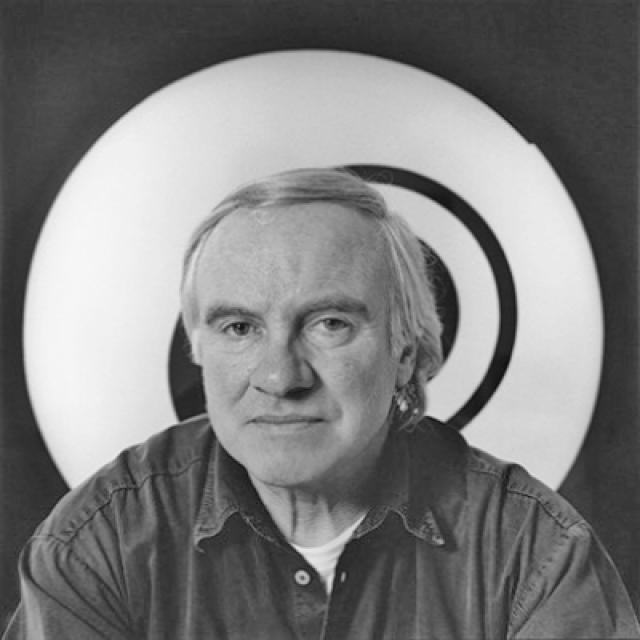
Patrick Caulfield was an English artist known for his distinctive and simplistic paintings.
Education and Early Career
Caulfield studied at the Chelsea School of Art (1956-1960) and the Royal College of Art (1960-1963), where he was a contemporary of David Hockney and R.B. Kitaj. After graduating, he returned to Chelsea as a teacher (1963-1971).
Pop Art Recognition
In 1964, Caulfield participated in the "New Generation" exhibition at the Whitechapel Gallery in London. This exhibition led to his work being associated with the Pop Art movement.
Distinct Style
Caulfield's paintings were characterized by their flatness, sharp outlines, and absence of shading. Examples of his early works include "Still Life with Dagger" (1963), "Artist's Studio" (1964), and "Sculpture in a Landscape" (1966).
Evolution of Style
In the mid-1970s, Caulfield began to incorporate more detailed and realistic elements into his work. For instance, "After Lunch" (1975) features a mix of sharply outlined objects and a realistically depicted plate of oysters. Later in his career, Caulfield returned to his earlier, more simplistic style.
Turner Prize Nomination
In 1987, Caulfield was nominated for the prestigious Turner Prize. However, Richard Deacon ultimately won the award.