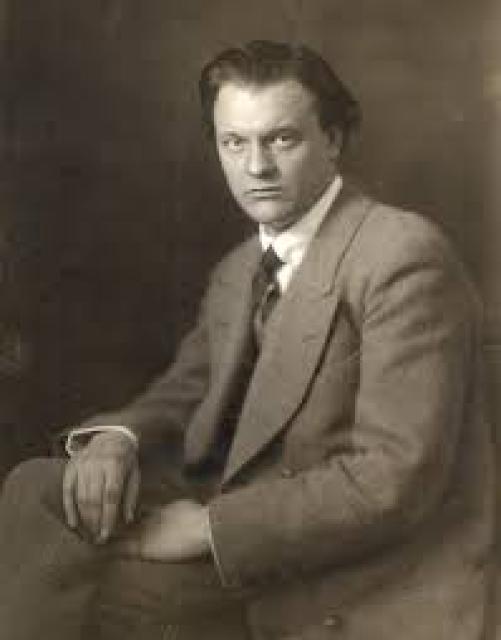
Paul August Klenau
 Denmark
- The Early Life of Paul von Klenau
- Years of Apprenticeship and Conducting
- A Focus on Composition
- Operas and Chamber Works
- Legacy of Paul von Klenau
The Early Life of Paul von Klenau
Paul von Klenau was a Danish composer and conductor of German descent. His musical journey began at the Copenhagen Conservatory from 1900 to 1902, where he honed his skills in composition and violin under the guidance of Otto Malling. Seeking further refinement, he moved to Berlin from 1902 to 1904 and became a pupil of Max Bruch (composition) and Karl Halir (violin).
Years of Apprenticeship and Conducting
In 1904, Klenau relocated to Munich and studied under Ludwig Thuille. After Thuille's death, he moved to Freiburg as the principal conductor of the city theater, continuing his lessons with Max von Schillings. From 1912 onwards, he divided his time between Freiburg and Frankfurt, where he led the choir of the Bach Society.
In the 1920s, Klenau's career blossomed in Copenhagen, where he became the conductor of the Danish Philharmonic Society from 1920 to 1926. He dedicated himself to promoting new music, particularly the works of Claude Debussy, Maurice Ravel, Alexander Scriabin, Frederick Delius, and most notably Arnold Schoenberg, who visited Copenhagen at Klenau's invitation to conduct his compositions. Concurrently, from 1922 to 1930, Klenau also led a choir in Vienna.
A Focus on Composition
In 1940, Klenau settled in Copenhagen and renounced his conducting activities, devoting himself entirely to composition. His Symphony No. 1 in F minor, premiered in 1908, was a resounding success, followed by eight more symphonies. His first opera, "Shulamith," was composed in 1913, and his second, "Kjarthan and Gudrun," based on ancient Scandinavian mythology, was premiered in 1918 under the baton of Wilhelm Furtwängler.
Operas and Chamber Works
Klenau's subsequent operas include "Die Lusterschule" (1926) and three operas using quarter-tone technique: "Michael Kohlhaas" (1933), "Rembrandt van Rijn" (1937), and "Elisabeth von England" (1941). His repertoire also encompasses various symphonic and chamber works, including vocal cycles such as "Das Cornet-Christoph Rilke-Lied" set to the poetry of Rainer Maria Rilke.
Legacy of Paul von Klenau
Paul von Klenau's musical legacy stands as a testament to his multifaceted talent as a composer and conductor. His innovative works, spanning symphonies, operas, and various chamber pieces, reflect his profound understanding of music and his relentless pursuit of artistic excellence.