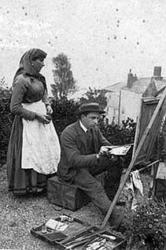
Paul Delvo
 Belgium
- Paul Delvaux: A Master of Surrealism
- Influences and Style
- The Allure of the Erotic
- Religious Symbolism
- The Poetics of Solitude
- Neoclassical Murals
- International Acclaim
- Legacy and Posthumous Recognition
- Death and Impact
Paul Delvaux: A Master of Surrealism
Early Life and EducationPaul Delvaux, a celebrated Belgian surrealist painter, was born on September 23, 1897, in Antheit, Belgium. He enrolled in the Royal Academy of Fine Arts in Brussels, where he honed his artistic skills.
Influences and Style
Delvaux's early work was influenced by Giorgio de Chirico and de Smet. He employed a distinctive style characterized by nude figures in enigmatic and atmospheric settings. The female nude became a central theme in his paintings, often depicted in surreal environments. His compositions typically featured meticulously defined urban landscapes, gardens, and ancient ruins.
The Allure of the Erotic
Delvaux's paintings often explored the contrast between clothed and nude figures, heightening their erotic undertones. His fascination with the nude body and its interplay with the architectural environment added a sensual dimension to his works.
Religious Symbolism
Delvaux also incorporated religious imagery into his compositions. In paintings like "The Crucifixion," skeletons take the place of figures, adding a macabre and reflective element.
The Poetics of Solitude
Delvaux's paintings captured the poetic essence of solitude and isolation. His depiction of night-time scenes, such as "Evening Trains," conveys a sense of eerie beauty and unfulfilled longings.
Neoclassical Murals
In addition to his easel paintings, Delvaux created impressive neoclassical murals. His work adorned the headquarters of J. Pierret in Brussels, demonstrating his versatility and mastery of different artistic styles.
International Acclaim
Delvaux's reputation extended beyond Belgium. His works are displayed in prominent museums worldwide, including the Metropolitan Museum of Art and the Museum of Modern Art in New York, the Tate Gallery in London, and the Centre Pompidou in Paris.
Legacy and Posthumous Recognition
In 1978, the Paul Delvaux Foundation was established to preserve and exhibit his work. The Paul Delvaux Museum opened in Saint-Idesbald, Belgium, in 1982, showcasing a comprehensive collection of his paintings and sketches.
Death and Impact
Delvaux passed away on July 20, 1994, in Woluwe-Saint-Pierre. He left behind a remarkable body of work that continues to captivate and inspire generations of art enthusiasts. As a pioneer of surrealism, Delvaux's unique vision and evocative imagery have secured his place in the annals of art history.