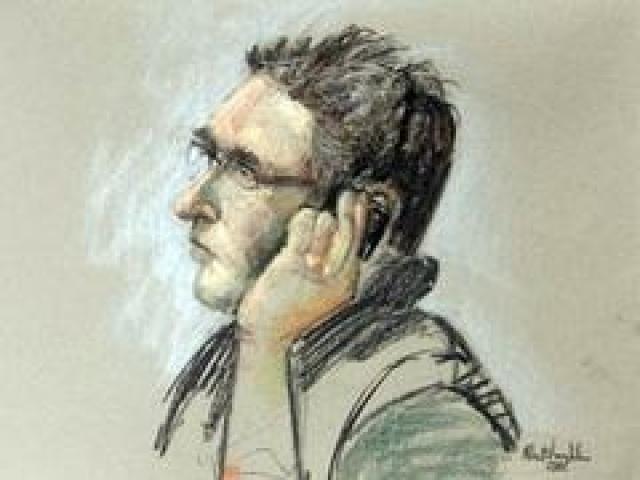
Paul Hempel
 Canada
Biography of Paul Hampel
Paul William Hampel, also known as the "Russian spy," was arrested by Canadian authorities on November 14, 2006. Initially, Canadian authorities claimed that Paul William Hampel was not his real name. In the only mention of him in independent sources, Hampel was referred to as a "beginning market analyst from Canada." On December 4, Hampel confessed to being a Russian and had been hiding under a false identity. Following this confession, the court decided to deport him, and he was deported on December 26.
Paul William Hampel, whose real name is Paul William Hampel, was arrested by Canadian authorities on charges of espionage. On November 9, 2006, Canada's Minister of Public Safety, Stockwell Day, and Minister of Immigration, Monte Solberg, signed an official security certificate, allowing the detention of the suspect based on classified evidence of his guilt. The certificate stated that the foreign citizen using the name Hampel was engaged in espionage activities in Canada, posing a threat to Canadian security. Hampel was arrested on November 14 at Montreal International Airport while attempting to leave Canada. During his arrest, fake birth certificates, a Canadian passport, a sum of $7,800 in five different currencies, several bank and credit cards, five SIM cards for mobile phones, two digital cameras, and a shortwave radio receiver were confiscated from him. Additionally, the suspected spy was found with cards containing notes on key events in Canadian history.
According to Canadian experts, Hampel's activities in Canada were in line with the traditional methods used by Russian illegal spies from the Foreign Intelligence Service (SVR). His arrest brought back memories of a similar case a decade earlier when SVR agents Dmitry and Elena Olshevsky were exposed in Canada. On November 21, the Federal Court of Canada, which received Hampel's case, published a list of charges against him. According to the evidence provided by the Canadian Security Intelligence Service (CSIS), the alleged Hampel was, in fact, a foreign citizen and an SVR agent who used illegally obtained data to create a fake birth certificate, which contained a real existing number and a false name. Using this forged document, Hampel obtained a Canadian passport in 1995 and renewed it in 2000 and 2005. Under this cover, he allegedly engaged in espionage activities in Canada and beyond for over ten years. CSIS requested that the court make a decision regarding the deportation of the alleged spy.
On November 22, 2006, at the request of Hampel's lawyer, Stephane Handfield, the court postponed the start of the hearings until the following week. The lawyer argued that more detailed familiarity with the case materials was necessary. No relatives or acquaintances of Hampel approached the authorities during this period. Handfield insisted that his client was born in Canada and was a Canadian citizen but did not provide any information to the public about Hampel's profession or family status. Nevertheless, the lawyer intended to prove the unfairness of the charges brought against Hampel. On November 28, the first hearing took place, during which prosecution witnesses testified. Dale Hopkins, a representative from the Central Bureau of Registration in Ontario, testified that there was no record of a person named Paul William Hampel being born in Ontario between 1960 and 1970 (Hampel's birth certificate stated that he was born in Toronto, the capital of Ontario, on December 11, 1965). The second witness was an analyst from CSIS, identified as "Anthony" for security reasons, who confirmed that Hampel's behavior closely resembled the methodology employed by SVR agents. On the same day, at the request of the defendant's lawyers, the hearings were postponed again. On December 4, the court decided to deport Hampel. It was revealed that on November 30, the defendant unexpectedly informed his lawyers that he was indeed not a Canadian and wished to return to his home country, Russia. As a result, the obstacles to deportation were removed. In court, Handfield read out a statement from his client, in which Hampel admitted to being a Russian citizen who had been illegally residing in Canada under a false name and had been born on October 21, 1961. However, he did not confess to engaging in espionage activities. He also revealed his true name, which was not disclosed. Although the court decision called for immediate deportation, the process was delayed until December 26, when Stockwell Day announced that the exposed spy had been sent back to Russia.
Canadian authorities did not provide detailed information about the activities of the alleged Hampel. However, journalists from the National Post publication managed to uncover that the arrested individual was the director of an offshore company in Montreal and traveled extensively, including visits to the Balkans. It is also known that in 2003, Hampel published a photo book titled "My Beautiful Balkans" in Belgrade. The book's information is available on a website of the same name, which provides brief information about the author of the photographs, referring to Hampel as a "beginning market analyst from Canada."


