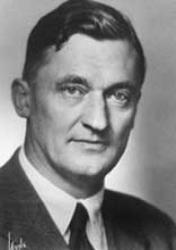
Paul Ners
 Great Britain
Biography of Paul Nurse
Paul Nurse, born on January 25, 1949, in Wembley, London, is a British biochemist and Nobel laureate in the field of medicine and physiology in 2001. He was awarded the Nobel Prize for his discovery of the regulation of the eukaryotic cell cycle by cyclin and cyclin-dependent kinases. Nurse is a member of the Royal Society and served as the President of Rockefeller University.
Early Life and Education
Paul Nurse's parents were originally from Norfolk, and he was born in Wembley, a district in northeast London. He completed his studies at the University of Birmingham in 1970, followed by a Ph.D. dissertation at the University of East Anglia (Norwich), where he obtained a Doctor of Philosophy degree in 1973. In 1976, Nurse identified the cdc2 gene in yeast (Schizosaccharomyces pombe), which controlled the cell cycle progression from the G1 phase to the synthetic S phase and from the G2 phase to mitosis. In 1987, Nurse discovered the homologous gene CDK1 in humans, which encodes the cyclin-dependent kinase.
Career
In 1984, Nurse joined the Imperial Cancer Research Fund (now Cancer Research UK). From 1988 to 1993, he served as the head of the Microbiology Department at the University of Oxford, before returning to the Cancer Research Fund, where he became the director in 1996. Since 2003, he has been the President of Rockefeller University in New York, where he continues his research on the cell cycle in yeast.
Awards and Achievements
Throughout his career, Paul Nurse has received numerous awards and honors. In 1989, he became a fellow of the Royal Society, and in 1995, he was awarded the Royal Medal. He was elected as a foreign member of the National Academy of Sciences in the United States in 1995. In 1998, he received the Albert Lasker Award for Basic Medical Research. In 2001, Paul Nurse, along with Timothy Hunt and Leland H. Hartwell, was awarded the Nobel Prize in Physiology or Medicine for their "discoveries of key regulators of the cell cycle." He was also honored with the Order of the Legion of Honour in 2002 and received the Copernicus Medal in 2005. In 2006, he became a foreign honorary member of the American Academy of Arts and Sciences.