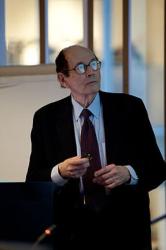
Leland Clark
 USA
USA- Leland C. Clark Jr.: Inventor, Pioneer, and Father of Biosensors
- Education and Career Beginnings
- Contributions to Artificial Oxygenation
- Father of Biosensors
- Pursuit of Artificial Blood
- Later Career and Legacy
Leland C. Clark Jr.: Inventor, Pioneer, and Father of Biosensors
Born on December 4, 1918, in Rochester, New York, Leland C. Clark Jr. was an American biochemist who made significant advancements in the field of medical devices and artificial blood.
Education and Career Beginnings
Clark earned his Bachelor of Science in Chemistry from Antioch College in 1941 and his PhD in Biochemistry and Physiology from the University of Rochester in 1944. He began his career as an Assistant Professor of Biochemistry at Antioch College, eventually serving as Chair of the Department of Biochemistry from 1955 to 1958.
Contributions to Artificial Oxygenation
During the 1940s and 1950s, Clark conducted groundbreaking research on artificial circulation systems, which later led to the development of the heart-lung machine. He also patented over 25 inventions, including the Clark electrode, a device for measuring oxygen levels in blood, water, and other liquids.
Father of Biosensors
Clark's invention of the Clark electrode revolutionized the measurement of oxygen and paved the way for the development of glucose sensors used by millions of diabetics. He was the first editor of the scientific journal "Biosensors & Bioelectronics" in 1985, solidifying his status as "the father of biosensors."
Pursuit of Artificial Blood
Clark dedicated much of his career to the development of artificial blood. He developed Oxycyte, a perfluorocarbon emulsion that could carry oxygen and potentially increase oxygen delivery to damaged tissues. Although he failed to develop a viable artificial blood during his lifetime, his research laid the foundation for future advancements in this field.
Later Career and Legacy
In 1968, Clark joined the Cincinnati Children's Hospital Research Foundation, where he remained until his retirement in 1991. After retirement, he co-founded Synthetic Blood International, which later became Oxygen Biotherapeutics, Inc. Clark received numerous awards, including the National Research Council Fellowship, the Horace Mann Award, and the Heyrovsky Award for his invention of the oxygen electrode. He passed away on September 25, 2005, and was posthumously granted membership in the Russian Diabetes Association in recognition of the 50th anniversary of his invention of the Clark electrode.