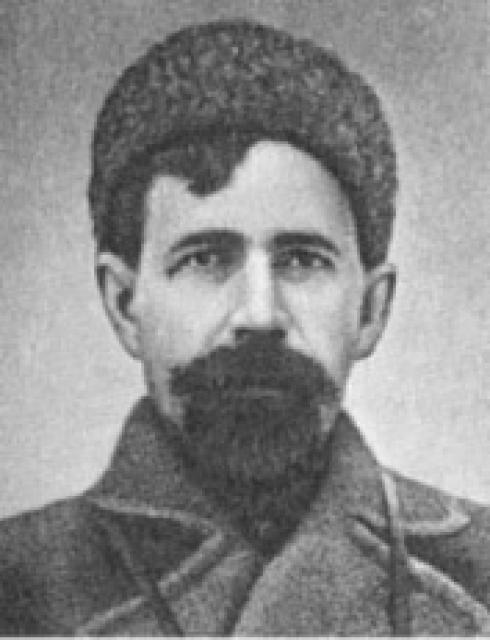
Pavel Dubenko
 Ukraine
- Biography of Pavel Dybenko
- Early Years and Revolutionary Activities
- Role in the October Revolution and Civil War
- Later Career and Personal Life
- Accusation and Execution
Biography of Pavel Dybenko
Pavel Dybenko was a Soviet state and military figure, who held the rank of Commander of the 2nd rank (1935). He was a member of the party since 1912. Dybenko was executed on July 29, 1938, but was rehabilitated in 1956. He was born in the village of Lyudkov in the Chernigov Governorate, into a peasant family.
Early Years and Revolutionary Activities
Before becoming a Soviet military leader, Pavel Dybenko was a Baltic sailor, an anarchist, and involved in the revolutionary movement since 1907. He joined the Baltic Fleet in 1911 and became one of the leaders of the anti-war movement among sailors on the battleship "Emperor Pavel I" in 1915. After being imprisoned for six months, he was sent to the front and later arrested again for anti-war propaganda, but was freed during the February Revolution in 1917.
Role in the October Revolution and Civil War
Dybenko was a member of the Helsingfors Council and became the chairman of the Central Baltic Committee ("Centrobalt") in April 1917. He actively participated in preparing the fleet for the October Armed Uprising. During the October Revolution, he commanded the Red detachments in Gatchina and Krasnoye Selo, where he arrested General P.N. Krasnov. Dybenko was then appointed as a member of the Council of People's Commissars and served as the People's Commissar for Marine Affairs until March 1918.
Throughout the Russian Civil War and the period of peaceful construction, Dybenko held command positions in the Red Army. He commanded a detachment of sailors near Narva in February 1918, but was defeated and surrendered the city. In May 1918, he faced trial for the loss of Narva, but was acquitted. In the same year, the battle of Narva, which took place on February 23, was declared a major victory and later became known as the Day of the Soviet Army.
Later Career and Personal Life
In the summer of 1918, Dybenko was sent to work underground in Ukraine. He was arrested in August 1918 but was exchanged for German prisoners of war in October. From November 1918, he held various command positions, including commander of a regiment, brigade, army group, and division. Dybenko became the commander of the 1st Zadneprovskaya Ukrainian Soviet Division, which included partisan detachments led by famous Ukrainian atamans Nikifor Grigoriev and Nestor Makhno.
Under the overall command of M.N. Tukhachevsky, Dybenko, leading the Combined Division, was one of the leaders of the suppression of the Kronstadt rebellion in 1921. He also participated in suppressing the peasant uprising in the Tambov region. In 1922, Dybenko was restored in the Russian Communist Party (Bolsheviks) with credit for his party membership since 1912.
In 1928-1938, Dybenko served as the commander of the troops in the Central Asian, Volga, and Leningrad military districts. He was a member of the Revolutionary Military Council of the USSR and the Central Executive Committee of the USSR. In 1937, he was elected as a deputy of the 1st convocation of the Supreme Soviet. During his leadership in the Leningrad Military District from 1936 to 1937, large-scale purges of the Communist Party's political staff were carried out for political reasons.
Accusation and Execution
In June 1937, Dybenko was part of the Special Judicial Presence that condemned a group of senior Soviet military leaders in the "Tukhachevsky Case". However, on February 26, 1938, Dybenko himself was arrested. During the investigation, he was subjected to beatings and torture. He confessed his guilt in participating in an anti-Soviet, Trotskyist, and militarist conspiracy, and on July 29, 1938, he was sentenced to death. Dybenko was also accused of being an American spy due to the fact that his sister lived in America and he had official meetings with American military representatives.
Pavel Dybenko was executed on the same day his sentence was pronounced. He was posthumously rehabilitated in 1956. Throughout his career, Dybenko received three Orders of the Red Banner and two Orders of the Red Star.


