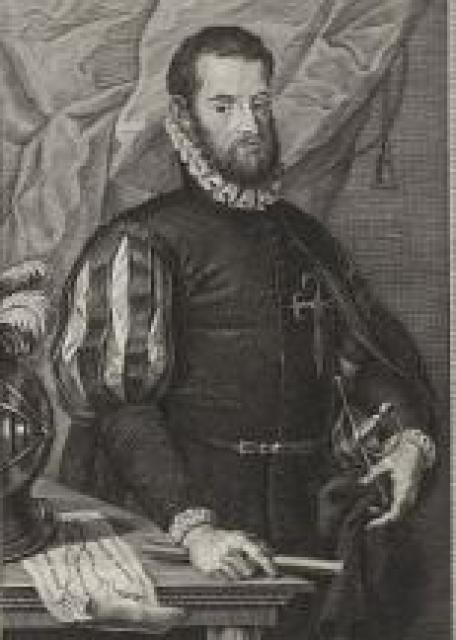
Pedro Menendez de Aviles
 Spain
SpainBiography of Pedro Menéndez de Avilés
Pedro Menéndez de Avilés was a Spanish admiral and explorer who is best known as the founder of the first permanent European settlement in North America - St. Augustine, Florida. Born into a wealthy Spanish noble family in the city of Avilés, Pedro escaped from home at the age of 14 and joined the fleet. In 1554, he was appointed captain of the fleet, a highly prestigious position that he obtained through his friendship with the king. Pedro was so close to the king that he even received an invitation to the royal party celebrating the wedding. Later, he was entrusted by King Philip to plan the movements and convoy system of one of the Spanish transport fleets, which served as the main link between Spain and its overseas colonies. Pedro was not only involved in tactical and organizational matters; together with Alvaro de Bazán, he designed trading ships. In 1560, Menéndez commanded galleons of one of the Spanish transport fleets headed for the Caribbean. King Philip II held both Pedro and his brother Bartolomé Menéndez in high regard. After delivering the fleet to its destination, Pedro requested permission to search for a lost ship along the way, but the king initially refused, even though Menéndez's son was aboard the missing ship. However, Pedro persisted, and eventually the king granted him the desired permission on the condition that Menéndez would explore and colonize Florida.
Exploration and Settlement in Florida
Pedro had to finance his own search expedition. Just before his departure, Menéndez received an additional order to destroy all Protestants encountered during his exploration of the new lands. Upon arriving in America, Menéndez established the settlement of St. Augustine, where the residents claim that Pedro celebrated the first Catholic Mass in the country. Shortly after the Mass, the Spanish forces launched an attack on Fort Caroline, a bastion of French Protestants. Through a combination of military experience and surprise, Pedro achieved a decisive victory, and a storm helped to defeat the French fleet. The Spanish did not take any prisoners, partly due to a shortage of provisions and partly due to religious reasons. A few weeks after the battle, Menéndez ordered the execution of over 300 surviving Frenchmen who had been shipwrecked south of St. Augustine. Today, this site of the gruesome execution is marked by a monument.
By destroying Fort Caroline, Menéndez gained control over virtually the entire coast of Florida. To consolidate his position, Pedro built a fortified fort in St. Augustine. Concurrently with the construction, Menéndez sent missionaries to the local Indian tribes and actively worked on exploring the surrounding lands. In his search for his son, Menéndez traveled to the southern part of Florida, where he encountered the Calusa tribe - a relatively advanced coastal tribe. Through difficult negotiations, Menéndez managed to reach a peaceful agreement with the Indians but was unable to find his son. During his search, Menéndez explored a significant portion of the surrounding lands and established valuable connections. Eventually, fate led him to Cuba, where he was appointed governor of the island.
Legacy and Death
Pedro Menéndez de Avilés passed away on September 17, 1574. His legacy includes the establishment of the first successful European settlement in Florida, St. Augustine, which remains the oldest permanent European settlement and port city in the continental United States. His expeditions and efforts in exploring and colonizing the region significantly influenced the history and development of North America.


