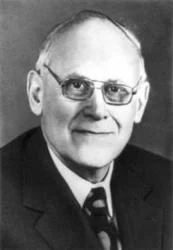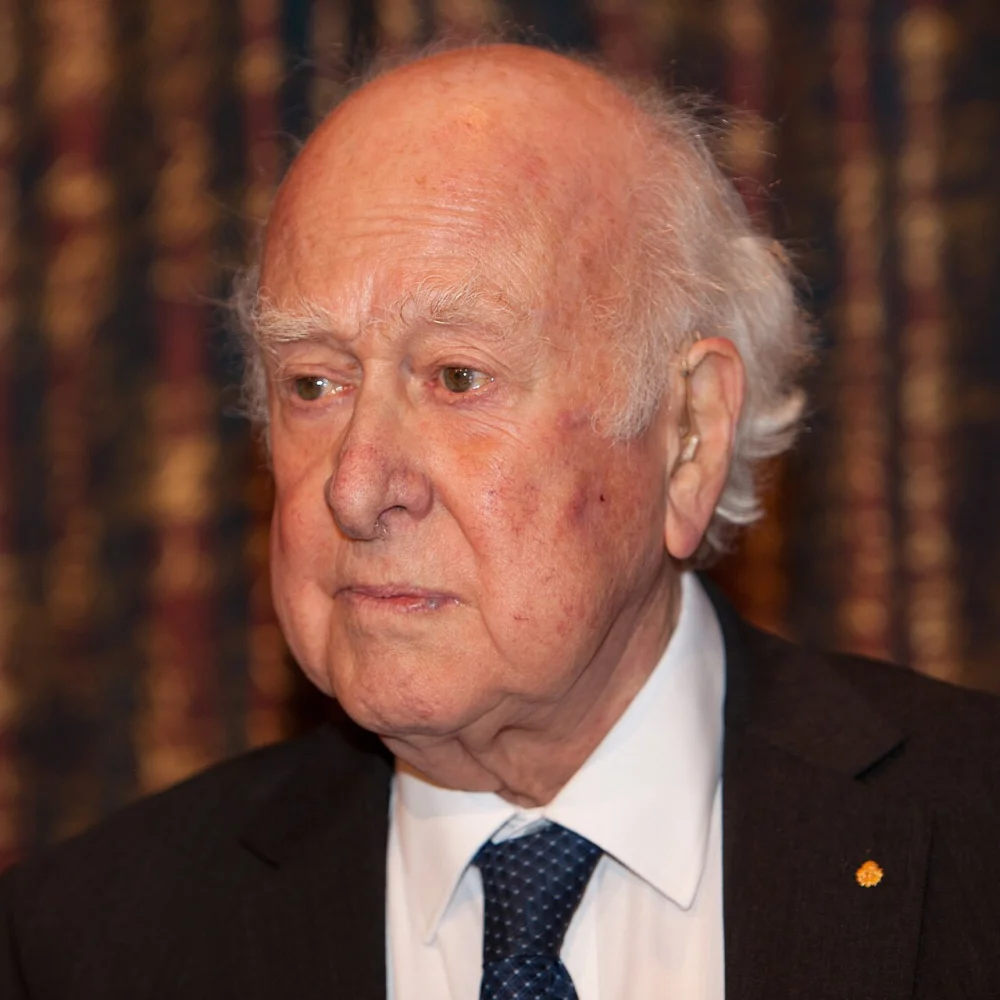
Peter Higgs
Peter Higgs proposed an idea that helped explain how some of the universe’s fundamental particles acquire mass. A quiet theoretical physicist at the University of Edinburgh, he put forward the mechanism in 1964 and predicted that it should have an associated particle. Decades later, experiments at CERN found a particle consistent with that prediction, making his name familiar far beyond physics.
From Newcastle to Edinburgh
Higgs was born in Newcastle upon Tyne, England, on May 29, 1929. His father worked as a sound engineer for the BBC, and the family moved several times during his childhood. Periods of poor health and wartime disruption interrupted his schooling, but he became fascinated by mathematics and physics.
He studied physics at King’s College London, graduating with first-class honours in 1950, and completed a doctorate there in 1954. After research appointments and teaching in London, he moved to the University of Edinburgh in 1960. He spent most of his working life there, becoming professor of theoretical physics in 1980 and professor emeritus in 1996.
A field and a predicted particle
In the early 1960s, physicists were trying to reconcile the idea that certain force-carrying particles should have no mass with the fact that the particles responsible for the weak nuclear force do have mass. Higgs proposed a field that fills space and interacts with elementary particles. Through this interaction, particles such as the W and Z bosons acquire mass, while the photon does not. The theory helped preserve the mathematical structure needed to describe the weak force.
Higgs was one of several physicists who independently developed related ideas in 1964, alongside François Englert and Robert Brout, and the teams of Gerald Guralnik, C. R. Hagen and Tom Kibble. A distinctive feature of Higgs’s paper was its prediction of a new massive particle associated with the field. That particle came to be known as the Higgs boson.
Finding it required a machine powerful enough to recreate the conditions of high-energy collisions and experiments capable of separating a rare signal from enormous amounts of data. On July 4, 2012, CERN announced that the ATLAS and CMS experiments at the Large Hadron Collider had found a new particle consistent with the Higgs boson. In 2013, Higgs and Englert received the Nobel Prize in Physics for the theoretical discovery of the mechanism that helps explain the origin of mass in subatomic particles.
Private life and public legacy
Higgs married linguist Jody Williamson in 1963. They had two sons and separated in 1972, though they remained friends. He was politically engaged, including in the Campaign for Nuclear Disarmament, and was known for a reserved manner. He disliked the media attention that followed the discovery and objected to the popular nickname “God particle,” which he considered misleading.
The discovery bearing his name is part of the Standard Model of particle physics, though it does not explain every aspect of mass: much of the mass of everyday matter, for example, comes from the energy binding quarks inside protons and neutrons. Higgs’s theoretical work supplied a crucial piece of the picture, one that took nearly half a century to test experimentally.
Higgs died in Edinburgh on April 8, 2024, aged 94. His story joined patient mathematical reasoning with a remarkable scientific confirmation: an idea proposed on paper in the 1960s became a central subject of one of the largest experimental projects ever undertaken.