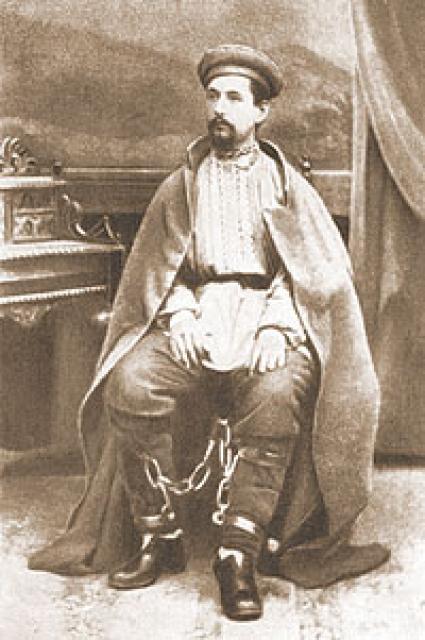
Peter Yakubovich
 Russia
- Early Life and Influences
- Literary Beginnings and Revolution
- Political Activism and Arrest
- Imprisonment and Exile
- Return from Exile
- Later Life and Beliefs
- Literary Legacy and Death
- Religious Beliefs
- "Pass on! Our paths do not intersect,
Early Life and Influences
Peter Yakubovich, unlike the "Tsarskoye Selo chicks," was not affiliated with any particular literary group. Rather, he belonged to a "galaxy of the dead," to which his ancestor, the Decembrist Alexander Ivanovich Yakubovich, had consigned himself. The poet adopted his ancestor's name and patronymic as his clandestine pseudonym.
From childhood, Peter Yakubovich was inspired by the example of Alexander Yakubovich's love of liberty and dignity. In adulthood, he was destined to wear the same chains as his predecessor. On the day of Ivan Turgenev's funeral in September 1883, an illegal pamphlet circulated among the crowd, rejecting the attempts of proponents of "pure art" to claim the late writer.
Literary Beginnings and Revolution
The author of this pamphlet was the 23-year-old Yakubovich. His impassioned prose revealed his poetic talent. While he would not become known for his extraordinary poetry, he would be remembered for his courageous actions.
Despite his literary aspirations, Yakubovich recognized the value of human integrity combined with inspiration. He believed that even those who were not literary stars could leave a legacy of meaningful words.
Political Activism and Arrest
In 1882, Yakubovich joined the "People's Will" revolutionary organization. He threw himself into writing, printing, and agitating until the day he was arrested and sent to Siberia with a shaved head and chains.
Imprisonment and Exile
After three years in the Peter and Paul Fortress, Yakubovich was sentenced to death, which was later commuted to penal servitude. He endured a grueling journey to Siberia, where he faced imprisonment and hard labor. Despite these hardships, he continued to write, smuggling his verses out of prison under pseudonyms.
Return from Exile
In 1903, Yakubovich was permitted to return to St. Petersburg, where he joined Vladimir Korolenko in editing the literary section of the magazine "Russian Wealth." His involvement in the events of 1905 led to a brief imprisonment in the Kresty Prison.
Later Life and Beliefs
Yakubovich never fully embraced Marxism or socialism. Like many Narodniks, he believed in a unique path for Russia, neither capitalist nor socialist, paving the way for the later convergence theory.
Literary Legacy and Death
Despite his modest aspirations as a poet, Yakubovich played an important role in Russian literature. His verse reflected his intelligence, strength, and unwavering faith in his ideals. He died in 1911 and was buried in the Volkovo Cemetery amidst thousands of mourners.
Religious Beliefs
In a world increasingly defined by religious ostentation, Yakubovich's words hold particular resonance:
"Pass on! Our paths do not intersect,
For such is the order of life:While those who weep for their fatherland
Bear a cross in their hearts, you bear one on your chest."





