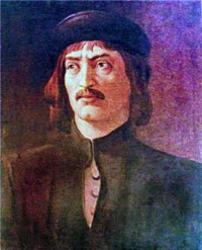
Petr Doroshenko
 Ukraine
Biography of Petro Doroshenko
Petro Doroshenko was the grandson of Mikhail Doroshenko and served as the Hetman of Malorossiya from 1665 to 1676. He began his military career as a colonel in the Pryluky regiment under the leadership of Bohdan Khmelnytsky and Ivan Vygovsky. Later, he became the colonel of the Cherkasy regiment. When Ivan Briukhovetsky fled Ukraine after being defeated by Teteria, Doroshenko attempted to seize power with the support of the Crimean Tatars. However, his alliance with Briukhovetsky was exposed, and he was captured by the Tatars. They offered to make him hetman if his former troops recognized him as their leader.
After Briukhovetsky's death and the surrender of Teteria's forces to the Polish government, Doroshenko established his authority over the right bank of the Dnieper River, except for Kyiv, which was defended by Moscow's troops. He aimed to unite and establish the independence of Malorossiya. Doroshenko convened a council that decided to expel the Poles from the right bank of Malorossiya. He also launched a campaign on the left bank, attempting to capture Kremenchuk. Though this attempt failed, Doroshenko remained determined and gained support from Metropolitan Iosif Nelyubovich-Tukalsky.
The Andrusovo Treaty, which divided Ukraine among the rulers, dashed the hopes of the Malorussian people for complete unification under Moscow's rule. This led Doroshenko's supporters to rally behind him, especially as Moscow's attempts at centralization threatened the Cossacks. However, Malorossiya was too weak to fulfill its goals independently, and Doroshenko had to seek foreign assistance. This undermined his cause, turning the struggle for national rights into a battle for control over Malorossiya among neighboring states, with the new and formidable enemy being the Turks.
Initially, Doroshenko's actions were successful. With the help of the Crimean Tatars, he successfully repelled Polish attacks and expanded his control to the left bank of the Dnieper. He tried to convince Bruihovetsky to rebel against Moscow's authority, promising to give him control over the right bank if successful. Bruihovetsky believed Doroshenko's promises and led a rebellion, but the Cossack regiments and senior officers joined Doroshenko on the left bank, resulting in Bruihovetsky's death. Doroshenko then marched against the Moscow voivode Romodanovsky but learned of his wife's betrayal. He fled to Chyhyryn, leaving Demian Mnohohrishny as his deputy hetman on the left bank.
During Doroshenko's absence, the unity achieved in Malorossiya quickly unraveled. The left bank elite, seeing no assistance from Doroshenko in their struggle against Moscow, chose to submit to Moscow's authority and elected Mnohohrishny as hetman. At the same time, Peter Sukhovienko, a Zaporozhian scribe supported by the dissatisfied Crimean Tatars, emerged as a candidate for hetman. Doroshenko's negotiations with the Moscow government to recognize him as hetman on the left bank were unsuccessful as he demanded the withdrawal of all Moscow voivodes and troops from Malorossiya's cities. The Russian government chose to confirm Mnohohrishny as hetman, and his final election took place in March 1669.
Threatened by both Poland and Sukhovienko with the support of the Tatars, Doroshenko could no longer hold onto his position, even on the right bank. In March 1669, he convened a council where the Cossacks of the right bank decided to submit to the authority of the Ottoman sultan. According to a document sent to Moscow at the time, Malorossiya retained full autonomy and freedom from Sultan's treasury taxes, only obliged to provide Cossack troops when demanded by the Sultan and having a voice in the external policy of the Ottoman Empire, especially regarding Poland and Moscow. However, these conditions likely differed from the authentic ones.
Doroshenko personally claimed the hereditary nature of the hetman's position in his family. However, the treaty with the Ottoman Empire tarnished his reputation in the eyes of the people. The majority of Cossacks turned away from Doroshenko and sided with Sukhovienko. The situation worsened for Doroshenko, and he decided to submit to Moscow but wanted to retain the title of hetman. He sought the mediation of Zaporozhian Koshevoy Serko, but Moscow rejected it. In the fall of 1676, Samoilovich and Romodanovsky launched a new campaign against Chyhyryn. Doroshenko surrendered and took an oath of allegiance. In 1677, he was sent to Moscow and never returned to his homeland. In 1679, he was appointed voivode of Vyatka, and three years later, he received the village of Yaropolche in Volokolamsk district of the Moscow province, where he died in 1698.
Doroshenko's actions failed to achieve his intended goals and instead further complicated the situation. The devastation of western Malorossiya left it without any significant autonomy, reducing it to a state near desolation.