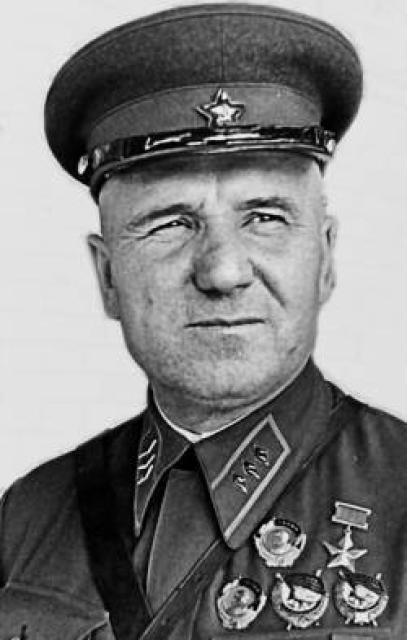
Philip Gorelenko
- Early Life and Military Service
- Revolution and Civil War
- Interwar Period
- Winter War and Heroism
- World War II and Senior Commands
- Post-War Career and Legacy
- Awards
Early Life and Military Service
Fyodor Dmitrievich Gorelenkowas born in the village of Ilyinka, now part of the Kushchevsky District in the Krasnodar Region, on an impoverished family of peasants. He joined the Imperial Russian Army in 1909 and rose through the ranks, graduating from regimental school and training command in 1911 and becoming a lieutenant in 1914. Gorelenko fought in World War I and was awarded the rank of poruchik (lieutenant).
Revolution and Civil War
After the outbreak of the Russian Revolution in November 1917, Gorelenko joined the Red Guard and became the commander of a detachment. In 1918, he joined the Red Army and began his service in the Civil War. Gorelenko led партизанских отрядов, regiments, brigades, and rifle divisions on various fronts, including the Western, Southern, Southeastern, and Caucasian.
Interwar Period
After the Civil War, Gorelenko served in the North Caucasus Military District, commanding various rifle regiments. In 1924, he graduated from advanced command courses and was transferred to the Moscow Military District. He held various command positions, including assistant commander of the 42nd Rifle Regiment. Gorelenko graduated from the RKKA "Vystrel" shooting and tactical improvement courses for command staff in 1927 and from the Frunze Military Academy in 1934.
Winter War and Heroism
With the outbreak of the Soviet-Finnish Winter War in 1939, Gorelenko commanded the 50th Rifle Corps, which fought on the Karelian Isthmus. His corps played a crucial role in breaking through the "Mannerheim Line" and capturing the city of Vyborg. For his exceptional leadership and personal courage, Gorelenko was awarded the title Hero of the Soviet Union, becoming the only corps commander to receive the honor in that war.
World War II and Senior Commands
Upon the establishment of general ranks in the Red Army in 1940, Gorelenko was promoted to Lieutenant General. He served as deputy commander of the Leningrad Military District and later commander of the 7th Separate Army. At the start of the Soviet-Finnish Continuation War in 1941, Gorelenko led the 7th Army during the defensive battles in Karelia. However, in September 1941, he was removed from command due to failures in leadership.
Gorelenko returned as commander of the 7th Army in November 1941 and later commanded the 32nd Army of the Karelian Front. He led his troops through the Svirsko-Petrozavodsk Offensive Operation in 1944, liberating Petrozavodsk and reaching the border with Finland.
Post-War Career and Legacy
After the war, Gorelenko held various positions, including assistant commander of the Belomorsky Military District and chairman of the Karelian-Finnish SSR's DOSARM committee. He was elected as a deputy to the Supreme Soviet of the Karelian-Finnish SSR for the first three terms. Gorelenko retired in 1951 and passed away in Leningrad on January 25, 1956. His name is honored by the Suoyarvski School in the Republic of Karelia, where the headquarters of the 7th Army was located in 1941.
Awards
- Three Orders of Lenin- Four Orders of the Red Banner
- Order of Kutuzov, 1st class