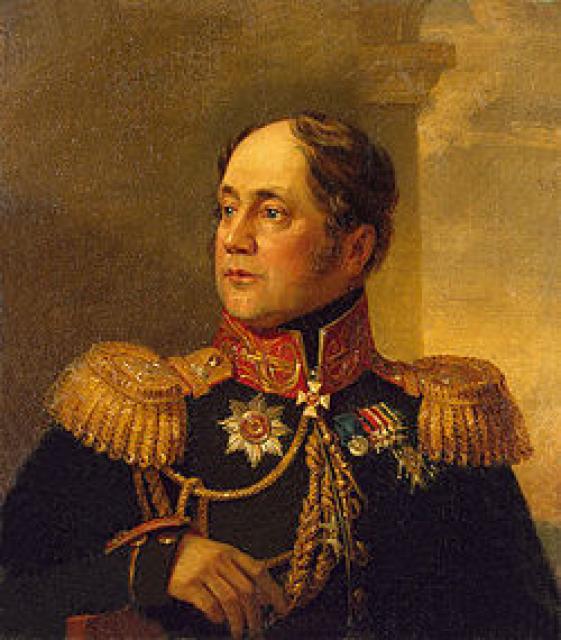
Nikolay Sipyagin
 Russia
- Biography of Ivan Ivanovich Sipyagin
- Early Life and Career
- Military Campaigns
- Rise and Recognition
- Moscow Campaign and Paris
- Post-War Service
- Caucasus and Death
Biography of Ivan Ivanovich Sipyagin
Ivan Ivanovich Sipyagin was a notable Russian military commander during the Napoleonic Wars.
Early Life and Career
Sipyagin was born to a noble family in the Kostroma province of Russia. He received a private education before enrolling in the College of Foreign Affairs in 1799. In 1800, he became a cadet in the Life Guards Semenovsky Regiment and was promoted to ensign in 1804.
Military Campaigns
Sipyagin distinguished himself in the Battle of Austerlitz, where he was wounded and received the Order of Saint Vladimir. He also fought in battles at Gutstadt, Heilsberg, and Friedland, earning the Golden Sword for his bravery. In the 1812 French invasion of Russia, Sipyagin served as aide-de-camp to Prince Constantine Pavlovich and later as an orderly to Peter Ivanovich Bagration. He participated in the battles of Shevardino and Borodino.
Rise and Recognition
Sipyagin's valor earned him promotion to полковник in 1812 and the Order of Saint George, 4th class, in 1813. He played a key role in negotiations with the Austrians and distinguished himself in the battles of Bautzen, Reichenbach, and Gerlitz. In 1813, he was promoted to генерал-майор for his actions at Kulm. He also received the Order of Saint Anne, 1st class, and several foreign decorations for his role in the Battle of Leipzig.
Moscow Campaign and Paris
In 1814, Sipyagin commanded a flying detachment and distinguished himself at Arcis-sur-Aube and in the capture of Paris. He was rewarded with the Order of Saint George, 3rd class, and the rank of генерал-адъютант.
Post-War Service
After the war, Sipyagin became chief of staff of the Guards Corps, where he established a military journal and library. However, his reforms clashed with the views of Prince Constantine Pavlovich and Count Alexei Arakcheev, leading to his transfer to the army in 1819. He served as a divisional commander and continued to promote military education and training.
Caucasus and Death
In 1826, Sipyagin was promoted to генерал-лейтенант and appointed commander of a combined division in the Caucasus. He was later made military governor of Tiflis and led troops in battles against the Persians and Turks. In 1828, he succumbed to an inflammation of the lungs and was buried in Tiflis with great public mourning. His death was considered a "state loss" by the Caucasus Army command.



