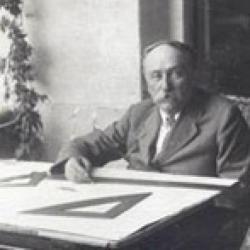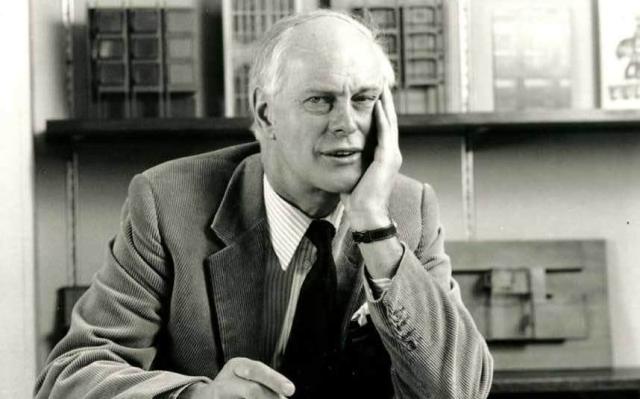
Philip Henry Manning Dowson
 Great Britain
Philip Henry Manning Dowson was a British architect whose postwar modernism combined rigorous structure with close attention to landscape, materials and the lives of the people who would use a building. Born in Johannesburg on 16 August 1924, he became a founding partner of Arup Associates and helped shape the look of university colleges, offices and cultural venues in Britain. He later brought the same curiosity about design to his leadership of the Royal Academy of Arts.
From Wartime Service to Architecture
Dowson’s family returned to England in 1927, settling in rural Norfolk. After attending Gresham’s School, he studied mathematics for a year at Oxford before joining the Royal Navy during the Second World War. He served aboard HMS Ursa in the Atlantic and Pacific, including during the Normandy landings and the Okinawa campaign.
When he left the Navy in 1947, Dowson went to Clare College, Cambridge, to study art history. He then trained at the Architectural Association in London, where he developed the technical and visual grounding that would guide his work. In 1953, he joined the office of engineer Ove Arup, entering a practice that treated engineering and architecture as parts of a shared design process.
A New Kind of Modern Practice
A key early commission came in 1958, when Dowson was asked to design new buildings for Somerville College, Oxford. Rather than leave Arup to work independently, he stayed and helped establish Arup Associates in 1963 with Arup and colleagues including Ronald Hobbs and Derek Sugden. The multidisciplinary firm brought architects, engineers and quantity surveyors into the design process together.
Dowson’s architecture avoided a rigid modernist formula. His buildings often used exposed concrete frames, brick and steel, but their character came from how these materials responded to a particular site. The Long Wall House near Long Melford, Suffolk, created a strong connection between home and surrounding landscape. At Oxford and Cambridge, his college buildings adapted modern structure to the traditions of courtyards, gardens and shared spaces.
One of his best-known projects was the conversion of the old maltings at Snape, Suffolk, into a concert hall for Benjamin Britten’s Aldeburgh Festival. Working with Derek Sugden and others, Dowson made a modern performance space within the existing industrial buildings, retaining their essential character. Other significant projects included the Wolfson Building at Somerville College, the Sir Thomas White Building at St John’s College, Oxford, and offices and industrial facilities for clients such as IBM and Wiggins Teape. His work was recognized for being both practical and humane, with landscaped courtyards and internal streets that gave large complexes a sense of place.
Architecture and Public Life
Dowson became chief architect at Arup Associates and continued as a senior partner until retiring in 1990, later serving as a consultant. He was knighted in 1980 and received the Royal Gold Medal for Architecture in 1981. The Sir Thomas White Building, one of his Oxford college projects, was later listed for its architectural significance and refined use of concrete.
He was elected to the Royal Academy of Arts and served as its president from 1993 to 1999. During his tenure, the Academy secured the former Museum of Mankind building in Burlington Gardens, creating room for future growth. He also supported the landmark 1997 exhibition Sensation, which introduced a new generation of British artists to a broad public.
Dowson died on 22 August 2014, six days after his 90th birthday. His career joined architecture and civic responsibility: he designed buildings intended to serve everyday life while helping institutions adapt to changing needs. The result was a form of modernism that could be technically ambitious without losing sight of its surroundings.