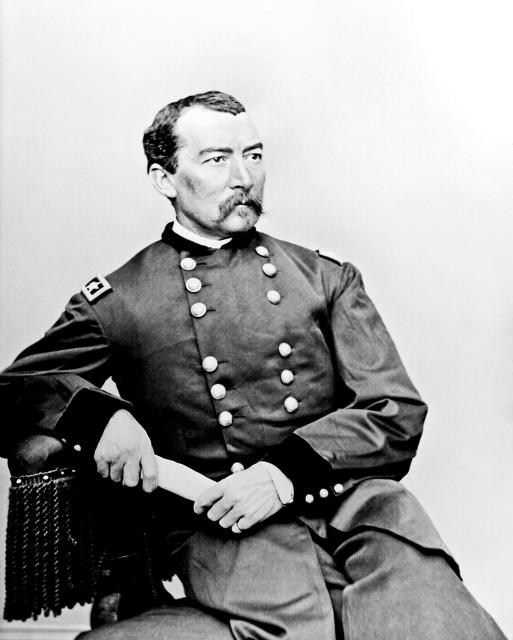
Philip Henry Sheridan
 USA
USABiography of Philip Henry Sheridan
Philip Henry Sheridan was a general in the Union Army during the American Civil War. He was born in 1831 in New York, according to his own statements. Sheridan graduated from West Point in 1853 as an infantry officer. When the war broke out, he served in the Southeast Missouri Army Headquarters but was soon assigned to the cavalry regiment of Gordon Granger. He fought under Granger's command at the Battle of Boonville in northern Missouri.
In the summer of 1862, Sheridan took command of a cavalry division. His cavalrymen fought heroically at the battles of Perryville and Murfreesboro, but the turning point in Sheridan's career came during the Chickamauga and Chattanooga campaigns. Although Sheridan suffered a devastating defeat at the Battle of Bloody Run, he returned with renewed forces during the siege of Chattanooga and showcased the capabilities of the northern cavalry by easily defeating the Confederates at Missionary Ridge.
When General Grant moved east, Sheridan was appointed to lead a powerful independent cavalry corps. While formally part of the Army of the Potomac, Grant promised Sheridan full autonomy in tactical matters, which he delivered on. During the Wilderness Campaign, Sheridan requested permission from Grant to launch a raid against Richmond to intimidate the Confederates and divert attention from General Lee's army. Grant agreed, and on May 8, Sheridan's 10,000-strong force advanced. In the ensuing cavalry battle on May 11 near Yellow Tavern, which offered a view of Richmond's spires, the northern forces managed to push back the Confederates. Although they did not capture Richmond, Sheridan achieved his objectives: panic spread in the city, and General Jeb Stuart, the Confederate cavalry commander, was mortally wounded in the battle.
In 1864, when Early's raid on Washington threatened the capital, Sheridan was assigned to lead the Army of the Shenandoah, specifically created to counter Early's threat in the Shenandoah Valley. Sheridan dealt a significant blow to Early's army in the Valley and earned the gratitude of Congress. However, Sheridan ended his time in the Valley by ruthlessly burning it to prevent its further use as a Confederate granary.
In the following year, Sheridan participated in all of General Grant's victorious battles and was among those who witnessed the surrender of the Confederate Army of Northern Virginia. After the war, Sheridan remained in the regular army and served in the Reconstruction governments of Texas and Louisiana. In 1884, he became the commanding general of the United States Army. Sheridan held this position until his death in 1888.