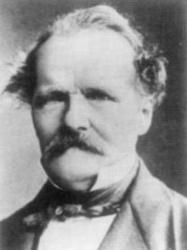
Pierre Laurent Wantzel
 France
Biography of Pierre Wantzel
Pierre Wantzel was a French mathematician known for his rigorous proof of the unsolvability of the ancient problems of doubling the cube and trisecting an angle.
Early Life and Education
Pierre Laurent Wantzel was born into a family of army officers in France. In 1821, his father left the military and pursued scientific research, eventually becoming a professor of applied mathematics at the École spéciale du Commerce in Paris. From a young age, Pierre showed a keen interest in mathematics and would often discuss mathematical problems with his father. At the age of 12, in 1826, Wantzel enrolled in the École des Arts et Métiers de Châlons, and the following year he transferred to Collège Charlemagne, from which he graduated with honors.
Academic Career
From 1832 to 1834, Wantzel studied at the École Polytechnique, and then at the École des Ponts et Chaussées. After serving as an engineer for several years, he returned to the École Polytechnique and became a professor of applied mechanics in 1838. Starting from 1841, he also taught at the École des Ponts et Chaussées, as well as several other educational institutions in Paris and its suburbs, including Collège Charlemagne.
Contributions to Mathematics
In 1837, Wantzel published his most famous work, which provided a proof for the unsolvability of the classical problems of doubling the cube and trisecting an angle. He also proved that it is impossible to construct a regular polygon using only a compass and straightedge if the number of sides does not satisfy Gauss's condition, which means it cannot be expressed as a power of 2 multiplied by distinct Fermat primes (known as Gauss-Wantzel theorem).
In addition to this groundbreaking work, Wantzel published around 20 articles on mathematics, mechanics, and aerodynamics. Unfortunately, he passed away at the age of 33, reportedly due to overexertion. His premature death left the mathematical community with a lasting legacy of his contributions to the field.