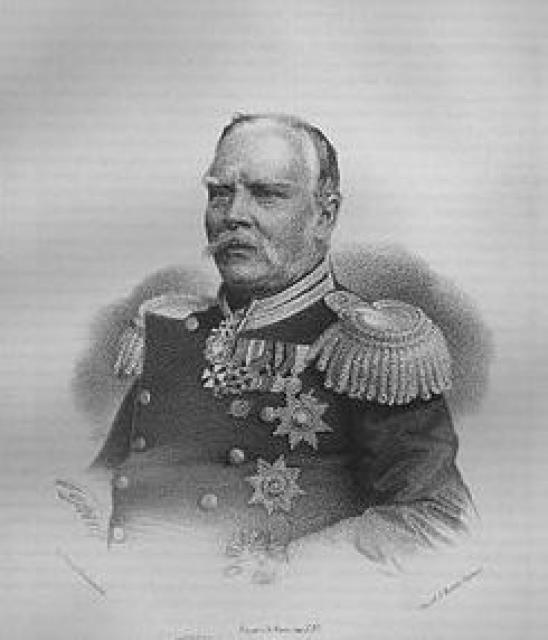
Platon Rokasovskiy
 Finland
Early Life and Education
Platon Ivanovich Rokasovsky (1797-1869) was born in Riga, Latvia, on an uncertain date with various sources claiming either 1797, 1799-1800, or 1800. His father, Ivan Nikitich Rokasovsky, was a colonel in the infantry while his mother, Charlotte von Albedil, passed away after 1800. Platon received his early education at home before joining the Institute of the Corps of Engineers of the Ways of Communication as a supernumerary student on January 3, 1811. Exceling in his studies, he was promoted to Lieutenant on July 17, 1812, at the tender age of 15 and retained as an instructor for further education in the officer classes.
Military Career
After graduating from the institute on June 16, 1815, Rokasovsky was assigned to the Suite of His Imperial Majesty for Quartermaster duties (General Staff) and promoted to Staff Captain on August 30, 1818. He was tasked with conducting a geographical survey of St. Petersburg for which he received the Order of St. Vladimir, 4th class on April 21, 1823.
Rokasovsky's military career began with the war against Turkey. He was promoted to Colonel and assigned to the 2nd Turkish Army, participating in the Siege of Silistria and the Battle of Kulevchi in 1829. His bravery earned him the Order of St. Anna, 2nd class, and a subsequent crown for the order. Sent to St. Petersburg for duty on February 13, 1830, he was appointed to the Separate Caucasian Corps.
Service in the Caucasus
In the Caucasus, Rokasovsky served under General Emmanuel and fought against the Adyghe. He was appointed Chief Quartermaster of the Separate Caucasian Corps on November 7, 1830, a position he held until 1831. He participated in numerous battles, receiving numerous decorations for his valor. In 1831, he was appointed Commissioner to establish a new border between Russia and the Ottoman Empire in Asian Turkey.
Rokasovsky led a force of troops in 1832 to protect the Russian border from lezgin raids and played a key role in the Dagestan expedition, suppressing rebellions and capturing settlements. His actions earned him a special commendation from the Emperor, a gold sword with the inscription "For Bravery," and the Order of St. Stanislaus, 2nd class with star.
Later Career and Legacy
Rokasovsky was appointed to the Nikolaev Academy of the General Staff in 1832 and later became Chief of Staff of the Separate Orenburg Corps in 1833. He served as Governor of Orenburg and received the Order of St. Stanislav, 1st class, in 1840. Appointed Quartermaster General of the War Ministry in 1842, he rose through the ranks to become Lieutenant General in 1847.
In 1848, he was appointed Assistant Governor of Finland and became Governor-General in 1854. Rokasovsky was praised for his leadership and was awarded the Order of St. George, 4th class, for his long and distinguished service. During the Crimean War, he commanded troops along the Baltic Sea coast from 1854 to 1855.
Returning to St. Petersburg, Rokasovsky became a member of the State Council and played a role in Finnish affairs. He was granted the title of Finnish Baron in 1855 and was appointed Governor-General of Finland once again in 1861, being promoted to General of Infantry.
Rokasovsky's second term as Governor-General was marked by significant reforms and the opening of Finland's first parliament in 1863. He advocated for Finnish autonomy while maintaining the connection with Russia. Recognized for his contributions, he was awarded the Order of St. Vladimir, 1st class with swords, in 1864.
Platon Ivanovich Rokasovsky passed away in 1869, leaving behind a legacy of dedicated service and a key role in shaping the relationship between Russia and Finland.


