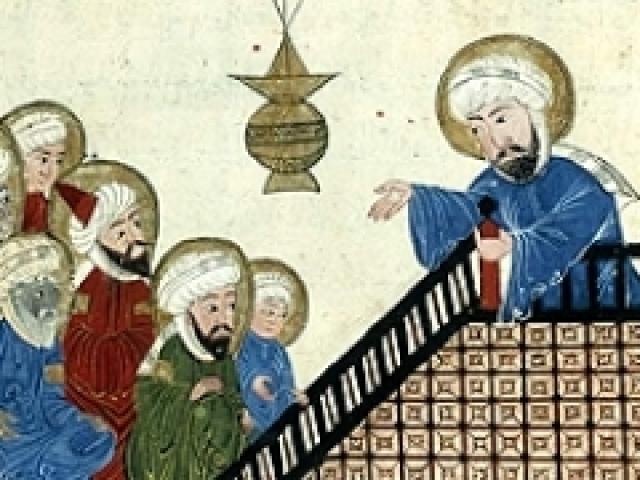
Prophet Muhammad
 Saudi Arabia
- Biography of Prophet Muhammad (Muhammad), Founder of Islam
-
When he turned 21, he obtained a position as a steward for the wealthy widow Khadijah, handling her trading affairs. While engaged in Khadijah's business, he traveled to many places and showed an interest in local customs and beliefs. At the age of 25, he married his employer. The marriage was happy, but Muhammad was drawn to spiritual quests. He would retreat to the desert valleys and immerse himself in deep contemplation. In 610 AD, in a cave on Mount Hira, Muhammad saw a radiant figure of God who instructed him to memorize the text of revelation and called him the "Messenger of Allah."
The Spread of Islam
- Persecution and Migration
- Final Years and Legacy
Biography of Prophet Muhammad (Muhammad), Founder of Islam
Prophet Muhammad, the founder of Islam, was born in Mecca around 570 AD (according to some versions - on April 20 or 22, 571). Muhammad's father died shortly before his birth, and when he was 6 years old, he lost his mother. Two years later, his grandfather, who had been taking care of him, passed away. Young Muhammad was raised by his uncle Abu Talib. At the age of 12, Muhammad went on a trading trip to Syria with his uncle, immersing himself in the atmosphere of spiritual quests associated with Judaism, Christianity, and other religions. Muhammad worked as a camel driver and then became a merchant.
When he turned 21, he obtained a position as a steward for the wealthy widow Khadijah, handling her trading affairs. While engaged in Khadijah's business, he traveled to many places and showed an interest in local customs and beliefs. At the age of 25, he married his employer. The marriage was happy, but Muhammad was drawn to spiritual quests. He would retreat to the desert valleys and immerse himself in deep contemplation. In 610 AD, in a cave on Mount Hira, Muhammad saw a radiant figure of God who instructed him to memorize the text of revelation and called him the "Messenger of Allah."
The Spread of Islam
Starting with preaching among close associates, Muhammad gradually expanded his circle of followers. He called upon his fellow tribesmen to worship one God, live a righteous life, and observe the commandments in preparation for the impending Day of Judgment. He spoke of the omnipotence of Allah, who created mankind and all living and non-living beings on earth. He viewed his mission as a commandment from Allah and referred to biblical figures such as Moses, Joseph, Zachariah, and Jesus as his predecessors. Ibrahim (Abraham), recognized as the forefather of Arabs and Jews and the first to preach monotheism, occupied a special place in Muhammad's teachings. Muhammad claimed that his mission was to restore the faith of Abraham.
Persecution and Migration
The aristocracy of Mecca saw his teachings as a threat to their power and organized a conspiracy against Muhammad. Upon learning of this, his companions convinced him to leave Mecca and migrate to the city of Yathrib (later renamed Medina) in 632 AD. Some of his followers had already settled there. It was in Medina that the first Muslim community was formed, strong enough to launch attacks on caravans coming from Mecca. These actions were seen as a punishment for the Meccans' expulsion of Muhammad and his followers, and the proceeds were used for the community's needs. Later on, the ancient pagan sanctuary of the Kaaba in Mecca was declared a Muslim holy site, and from that time on, Muslims began to pray, facing Mecca. The inhabitants of Mecca took a long time to accept the new faith, but Muhammad managed to convince them that Mecca would retain its status as a major commercial and religious center.
Final Years and Legacy
Shortly before his death, the Prophet visited Mecca, where he destroyed all the pagan idols surrounding the Kaaba. On June 8, 632, Muhammad completed his earthly journey and was buried in Medina. His teachings, recorded in the Quran, formed the basis of the Islamic faith, which spread rapidly throughout the Arabian Peninsula and eventually beyond, becoming one of the world's major religions. Muhammad is revered as the last and greatest prophet in Islam, with his life and teachings serving as a guide for Muslims worldwide.


