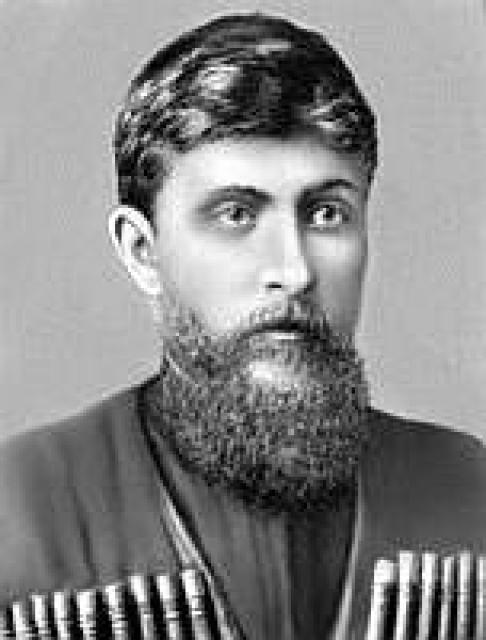
Pshavela Vazja
 Georgia
- Early Life and Education
- Teaching and Literary Beginnings
- Literary Career
- Themes and Characters
- Notable Works
- Nature Poetry
- Legacy and Recognition
Early Life and Education
Born on July 14 (26), 1861, in the village of Charghali, Luka Pavlovych Razikashvili was destined to become the renowned Georgian writer, known as Vaza-Pshavela. His family hailed from a priestly background, and he received his early education at the Telavi Theological Seminary and the Gori Teacher's Seminary. During this time, he forged connections with Georgian populists.
Teaching and Literary Beginnings
Upon graduating from the seminary in 1882, Vaza-Pshavela pursued a teaching career in rural areas, championing the rights of peasants. In 1883, he audited courses at the Faculty of Law at St. Petersburg University but faced financial constraints and returned home in 1884. He engaged in farming, herding, and hunting.
Literary Career
Vaza-Pshavela entered the literary scene in the mid-1880s, capturing the essence of contemporary Pshav society in his works. His prolific oeuvre includes 36 poems, approximately 400 ballads, plays, short stories, as well as ethnographic, publicistic, and critical articles.
Themes and Characters
Vaza-Pshavela's writings encompass diverse themes, exploring human-society dynamics, humanity's relationship with nature, and the complexities of love and duty. His poems "Wounded Leopard" (1890) and "Letter of a Pshav Soldier to His Mother" (1915) highlight his appeal to fight against external and internal foes.
Notable Works
In his epic poems "Aluda Ketelauri" (1888) and "Guest and Host" (1893), Vaza-Pshavela delves into the conflict between individuals and the traditional village community. His play "The Outcast" (1894) also reflects this theme.
Nature Poetry
As a nature enthusiast, Vaza-Pshavela emerged as an unparalleled voice in Georgian poetry. His depictions of nature are vibrant and evocative, revealing the interplay of movement and inner conflicts.
Legacy and Recognition
Vaza-Pshavela's death on June 27 (July 10), 1915, left a profound void in Georgian literature. His works have been widely translated into Russian and other foreign languages, making him accessible to audiences beyond Georgia. His remains are laid to rest in the Pantheon on Mount Mtatsminda in Tbilisi.