Pytheas
- Life in Massalia
- The voyage into the Atlantic
- Thule and the far north
- A careful observer of nature
- Reputation and legacy
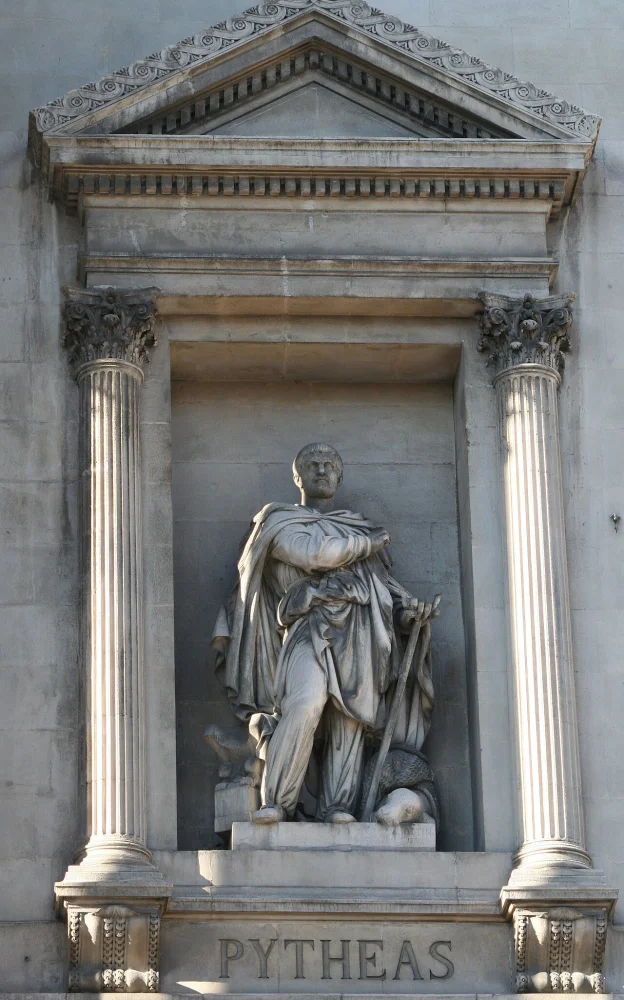
Pytheas of Massalia was a Greek explorer whose voyage into the North Atlantic carried the known world far beyond the Mediterranean map. Around the late fourth century BCE, he travelled along the Atlantic coasts of Europe, reported on Britain, and described a distant northern land he called Thule. His book is lost, but later writers preserved fragments of an account that still shapes discussions of ancient exploration.
Life in Massalia
Pytheas lived in the Greek city of Massalia, modern Marseille, on the coast of southern France. Almost nothing is known about his family, education, or personal life. He was active around the time of Alexander the Great, probably in the late fourth century BCE, and appears in ancient sources as both a navigator and an observer of geography and astronomy.
His voyage and writings survive only through references by authors such as Strabo, Diodorus Siculus, and Pliny the Elder. These writers lived centuries later and did not always trust his reports. Strabo in particular criticized some of his claims, and the surviving picture of the voyage is pieced together from scattered quotations and summaries.
The voyage into the Atlantic
Pytheas’ lost account, often called *On the Ocean*, described a journey from the western Mediterranean up the Atlantic coast. Ancient sources associate his route with the coast of Iberia and western Gaul, Cornwall, and the British Isles. He reported on Britain’s shape, climate, peoples, and resources, and later writers credited him with sailing around the island.
His descriptions connect the voyage with the trade in tin from southwestern Britain. He wrote about a place called Ictis where tin was gathered and exchanged, though the location remains uncertain. He also described amber from lands near the northern sea, offering Greek readers information about trading networks that reached far beyond their usual horizon.
The scale and exact route of the expedition remain debated. Some reconstructions take Pytheas as far as the Baltic; others are more cautious about how far north and east he travelled. The surviving evidence gives no complete itinerary, so modern maps of his route remain hypotheses rather than settled fact.
Thule and the far north
The most famous place in Pytheas’ account was Thule, described as lying several days’ sail north of Britain. He reported a region where the sea, land, and air seemed to merge, perhaps describing conditions of ice, fog, and rough northern waters. Later generations used “Ultima Thule” to mean the farthest edge of the known world.
The identity of Thule is unresolved. Scholars have proposed Norway, Iceland, the Faroe Islands, or other northern locations. Pytheas’ reported astronomical observations and latitude estimates help researchers evaluate these possibilities, but they have not produced a consensus.
A careful observer of nature
Pytheas was not only a traveler. He used astronomical observations to estimate latitude and to describe how daylight changed in northern regions. He also connected tides with the phases and movements of the Moon, an observation that later writers regarded as noteworthy. His account of the sea and sky treated travel as a way to gather measurable knowledge about the natural world.
In this respect, Pytheas belonged to a wider Greek tradition that joined navigation, astronomy, and geography. His voyage offered evidence about how far north the inhabited world extended and how different environments affected life and commerce.
Reputation and legacy
Some ancient writers dismissed Pytheas as unreliable, partly because his northern reports challenged what they thought possible. Strabo repeated skeptical judgments, while later authors also preserved details that appear to derive from Pytheas’ own observations. The tension between distrust and reliance is one reason historians read the fragments cautiously rather than accepting every story at face value.
No complete copy of *On the Ocean* survives, and Pytheas’ own voice is almost entirely lost. Yet his reported voyage remains a remarkable episode in the history of exploration. By describing Britain, the northern seas, and Thule, he expanded Greek geographical imagination and left later generations a map with a compelling blank at its edge.