Rafael Grugman
 Ukraine
- Early Life and Education
- Return to Odessa and Engineering Career
- Journalism and Artistic Writing
- Immigration to the United States
- Writing in America
- Publications and Recognition
- Engagement in Public Discourse
- "Nontraditional Love": A Dystopian World
Early Life and Education
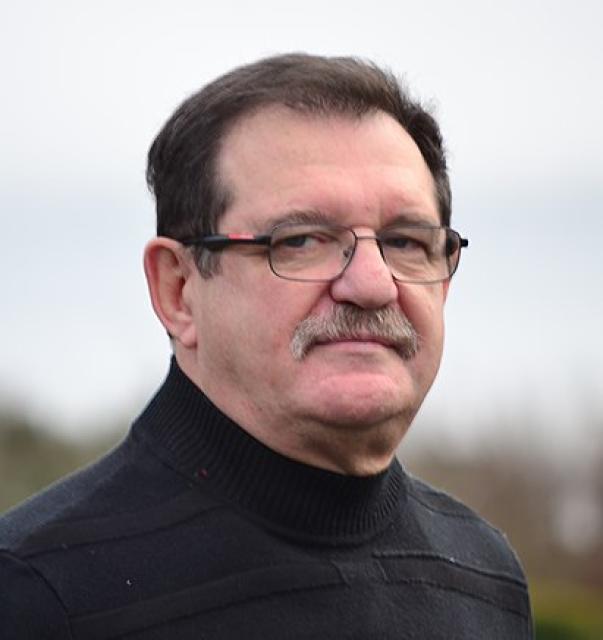
Rafael Grugman was born on October 16, 1948, in Odessa, Ukraine, to Abram Borisovich Grugman, an employee at the Kinap plant, and Evgenia Samoilovna Rivilis, a primary school teacher. His mother was a graduate of the Jewish department of Odessa Pedagogical Institute's literature faculty in 1937, a year that saw the arrest of most of the department's faculty.
Grugman completed Odessa School No. 39 in 1966 and graduated from the Novosibirsk Electrotechnical Institute (NETI) in 1971, which later became Novosibirsk State Technical University (NSTU). During his university years, he contributed to the Novosibirsk newspapers, including "Sovetskaya Sibir" and "Molodost Sibiri," and worked as a literary employee for the newspaper "Energiya." He also conducted research with the History of the Communist Party of the Soviet Union department.
Return to Odessa and Engineering Career
After graduating, Grugman returned to Odessa and worked in a design bureau until the collapse of the Soviet Union. As an engineer, he authored over 50 articles and obtained numerous patents in technical journals in Moscow.
Journalism and Artistic Writing
With the onset of perestroika, Grugman re-entered journalism. He was published in newspapers such as "Vechernyaya Odessa," "Odessa Vestnik," "Vsemyrnye Odesskie Novosti," "Porto-Franko," and the almanac "Deribasovskaya-Richelievskaya." He also actively collaborated with the Israeli Fund for Culture and Education in the Diaspora and the Odessa Society for Jewish Culture.
In 1993-94, Grugman served as the editor of "Ha-Melitz," the first Jewish newspaper published in Odessa post-Soviet era. During this time, he published his first novel, "Bride of the Sea" (1994), followed by "Borya, Come Out of the Sea" (1995) and "I Don't Need Your Stuffed Fish" (1996).
Immigration to the United States
In 1996, Grugman emigrated to the United States. In New York, he worked for an internet company, served as a manager at IBM, and became a professor at a New York college from 1997 onwards.
Writing in America
Grugman's short stories and novellas were published in Russian-language newspapers in New York and San Francisco, as well as in Israeli magazines such as "Kol-Ha-Uma" and "We're Here." In 2008, Liberty Publishing House in New York published his dystopian novel "Nontraditional Love," which was nominated for the Award for Excellence in Russian to English Literary Translation at the 2009 Rossica Translation Prize at the London Book Fair.
Publications and Recognition
Grugman's works have been published in Russian, English, Ukrainian, and Israeli, both in Russia, Ukraine, the United States, and Israel. He has authored historical and artistic books, including the dystopian novel "Nontraditional Love."
Engagement in Public Discourse
In 2020, Grugman penned a petition to the US Congress and President Donald Trump, calling for a trial of Romania for the Holocaust. He also made predictions about Crimea's return to Ukraine and the potential third disintegration of the Russian Empire on RadioNVC and the online newspaper "Continent."
"Nontraditional Love": A Dystopian World
"Nontraditional Love" is a novel set in the 23rd-century United States that depicts an Orwellian world where heterosexual marriage and intimate relationships are forbidden. World history, the Bible, and classic literature are fabricated to support the ideology of a homosexual society.
The novel's protagonist, a heterosexual man, is forced to disguise himself as gay to survive in this dystopian world. "Nontraditional Love" has sparked controversy, eliciting criticism and praise from both supporters and opponents of same-sex marriage and love. Literary critics have noted the significance of its exploration of homosexuality in the dystopian genre.