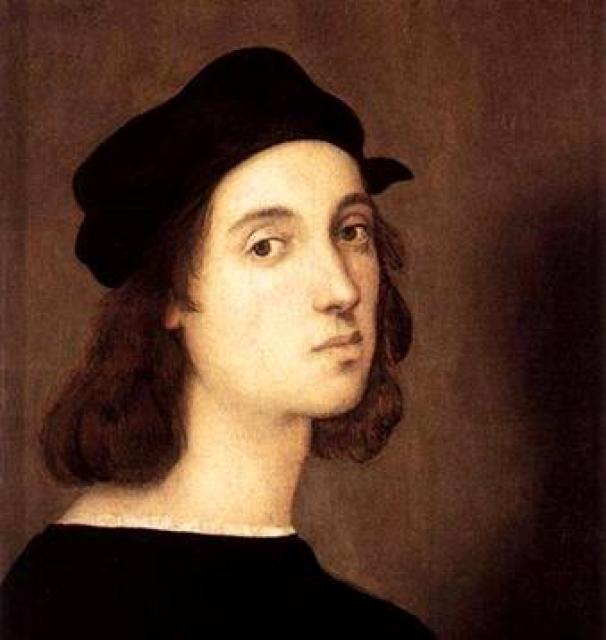
Rafael Santy
 Italy
Italy- Biography of Raphael Sanzio
- Early Works
- Florentine Period
- Return to Urbino and Later Works
- Later Career and Legacy
Biography of Raphael Sanzio
Raphael Sanzio, an Italian painter, was born in the renowned Italian city of Urbino in 1483. He was gifted to the world by nature, as it desired to be conquered not only by art but also by righteousness. His exceptional achievements were equal to his personal charm. It was in him that diligence, beauty, modesty, and great talent shone brightly. His father, Giovanni dei Santi, was a painter of moderate distinction but a gifted man capable of guiding his children on the right path. When Raphael grew up, his father began to train him in painting, as he noticed his great inclination and extraordinary talent for this art. After a few years, Raphael, still a young boy, became an excellent assistant in many works that Giovanni carried out for the Urbino state. Eventually, when his exemplary and loving father realized that Raphael could learn little more from him by staying with him, he decided to place him under Pietro Perugino, who was considered the leading painter at that time. In 1500, Raphael was admitted to the workshop of Perugino to pursue his studies.
Early Works
Soon, Raphael mastered Perugino's style so well that his copies could not be distinguished from the originals painted by his teacher. This is evident in the figures he painted in the church of San Francesco in Perugia for Madonna Maddalena degli Oddi. The figures include the Assumption of the Virgin and Jesus Christ crowning her, as well as the twelve apostles surrounding the tomb, contemplating a heavenly vision. In the predella, divided into three scenes, there are the Annunciation, the Adoration of the Magi, and the Presentation of Jesus in the Temple. These works were executed with exceptional skill, and anyone unfamiliar with this style would firmly believe that they were painted by Pietro, when in fact, they were undoubtedly painted by Raphael. Other notable early works by Sanzio include "Archangel Michael Defeating Satan," "The Three Graces," and "The Knight's Dream." In the latter painting, the young knight, like the young artist, dreams sweet dreams. But even in his dream, he has to make a difficult choice between a book and a flower, between a difficult and an easy path in life.
Florentine Period
During his time in Florence, Raphael's move played a significant role in his artistic development. He had the opportunity to learn from Leonardo da Vinci, and he began to work extensively from life, studying anatomy, mechanics of movement, complex poses, and perspectives. His last Florentine works, such as "The Entombment" (1507, Borghese Gallery, Rome) and "Saint Catherine of Alexandria" (around 1507-1508, National Gallery, London), show an interest in the dramatic and emotionally charged movement developed by Michelangelo. The main theme of his paintings during this period was the Madonna and Child, with at least ten works dedicated to this subject.
Return to Urbino and Later Works
After his father's death, Raphael returned to Urbino, where he completed two small yet exquisite paintings in his second style for Guidobaldo, the military leader of the Florentines. He also painted a small picture depicting Christ praying in the garden and three apostles sleeping nearby for Guidobaldo. These works were executed with such precision that it is impossible to imagine miniatures better or differently painted. After these works, Raphael resolved his affairs and returned to Perugia, where he painted Saint John the Baptist and Saint Nicholas in the Church of the Brothers of Servite on a panel located in the Ansidei family chapel. In the San Severo monastery in Perugia, specifically in the Chapel of the Madonna, he painted a fresco of Christ in Glory and God the Father surrounded by angels and six seated saints on each side: Saint Benedict, Saint Romuald, Saint Lawrence, Saint Jerome, Saint Maurus, and Saint Placidus. This work was highly regarded at the time as an excellent example of fresco painting, and Raphael signed it with his name in large and clearly visible letters.
Later Career and Legacy
Raphael made a notable impact on Italian architecture as well. Among his architectural works are the small church of San Eligio degli Orefici (started around 1509) with its strict interior, the Cappella Chigi in the Church of Santa Maria del Popolo (started around 1512), which showcases the unity between architectural design and decoration developed by Raphael, and the unfinished Villa Madama. His fame and recognition spread beyond Italy to France and Flanders. The renowned German painter and engraver Albrecht Dürer sent Raphael his own works, including a self-portrait, which impressed Raphael, leading him to send Dürer many of his own drawings, which the German artist highly valued.
Sadly, Raphael's life was cut short. He passed away in Rome on April 6, 1520. Although his life was brief, it was enough time for him to be remembered as one of the great masters of the High Renaissance. His sudden death ended the rivalry between two great artists, Raphael and Michelangelo, who had collaborated in the creation and decoration of the Vatican. Michelangelo, who was older than Raphael, outlived him by many years. Raphael's remains were buried with the honors befitting such a noble spirit, and there was not an artist who did not shed bitter tears and bid him farewell on his final journey.




