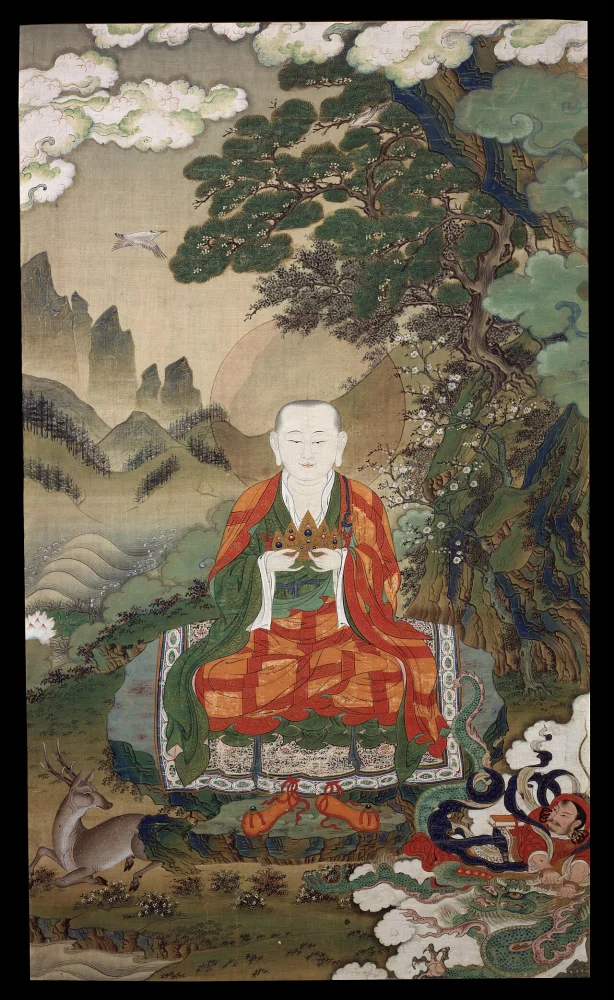
Rāhula
Rāhula occupies a distinctive place in Buddhist tradition: he is remembered as the son of Siddhārtha Gautama, the Buddha, and as one of the first children to enter the Buddhist monastic community. Rather than inherit a kingdom, the young prince is said to have received a spiritual inheritance through training, discipline, and insight.
Birth and Early Story
Buddhist accounts identify Rāhula as the son of Prince Siddhārtha and Yaśodharā. Traditions differ on details of his birth and the timing of his father’s departure from palace life, so the stories are best understood as part of the religious biography of the Buddha rather than as a fully documented chronology.
His name is often explained in Buddhist tradition as meaning “fetter” or “bond.” Later accounts connect it with the ties of family life that Siddhārtha was leaving behind when he set out on his spiritual quest. The name gave Rāhula’s story a striking symbolic edge: he was at once the prince’s beloved child and a reminder of the attachments the future Buddha hoped to transcend.
A Young Novice
According to Buddhist texts, after attaining enlightenment the Buddha returned to his family’s homeland of Kapilavastu. Rāhula’s mother encouraged him to ask his father for his inheritance. The story says that, instead of worldly wealth, the Buddha arranged for the boy to enter the monastic order. The elder Sāriputta ordained him as a novice, making Rāhula a model of the early Buddhist community’s willingness to welcome a child into religious life.
The account also points to a practical question raised by a young novice’s ordination: later tradition says that a rule was established requiring parental consent before a minor could be ordained. Rāhula thus became part of the story not only of a family reunion, but also of how Buddhist monastic practice developed.
Training and Teachings
The early discourses portray the Buddha as giving his son careful instruction. In the Ambalaṭṭhika Rāhulovāda Sutta, the Buddha teaches him to examine his actions before, during, and after carrying them out, with particular emphasis on honesty and avoiding harm. Another discourse, the Mahā-Rāhulovāda Sutta, uses reflection on the body and its elements as a path toward insight.
Later Buddhist tradition remembers Rāhula as diligent, patient, and eager to learn. He is often described as especially devoted to training, a reputation that made him an example for novice monks. Accounts say that he eventually attained arahantship, the liberation sought in early Buddhist teaching.
Legacy
Rāhula is remembered less for political or worldly achievements than for the way his story frames inheritance. In place of royal power, he received discipline and a path of practice. The discourses bearing his name continue to be studied for their direct advice on truthfulness, self-examination, and mindful conduct.
The details of his life reach readers through Buddhist scripture and later commentaries, which differ in chronology and narrative emphasis. Across those traditions, however, Rāhula remains a powerful figure: the Buddha’s son who became a monk, a student, and a lasting symbol of spiritual inheritance.