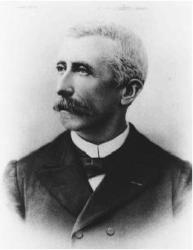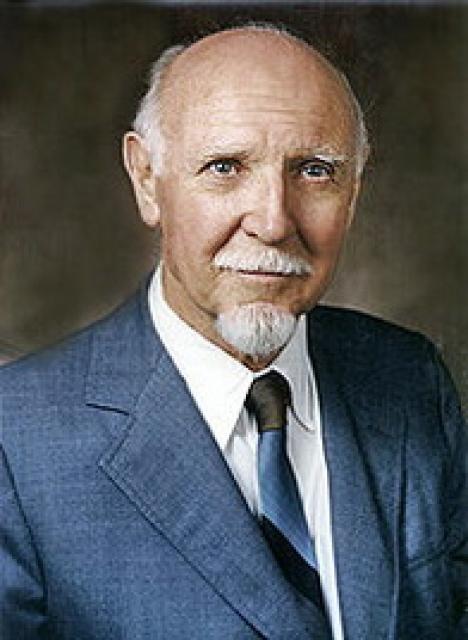
Raymond Bernard Cattell
 Great Britain
- Early Life and Education
- Influential Mentorship and Research
- Collaboration and Professorship
- Later Career and Legacy
- Key Theories and Contributions
- Comprehensive Research
- Personality Dynamics
- Cattell's Equation and Prediction
Early Life and Education
Raymond Bernard Cattell was born in 1905 in Staffordshire, England. At the age of 16, he enrolled in King's College London, where he studied chemistry and physics. In 1924, Cattell earned a bachelor's degree in chemistry from the University of London. However, shortly before completing his degree with honors, he decided to pursue a career in psychology. In 1929, he received his doctorate in psychology from the University of London.
Influential Mentorship and Research
As a postgraduate student, Cattell worked as an assistant to Charles Spearman, a distinguished psychologist who developed factor analysis. Cattell's research focused on identifying the underlying traits and abilities that define human personality. From 1932 to 1937, he served as the director of the Leicester City Mental Health Clinic. In 1937, he earned a Doctor of Science degree from the University of London.
Collaboration and Professorship
Cattell subsequently collaborated with Professor E.L. Thorndike at Teachers College, Columbia University in New York. In 1938, he became a professor of psychology at Clark University, and later in 1941, a lecturer at Harvard University. In 1944, Cattell joined the University of Illinois as a Research Professor of Psychology. There, he directed the Laboratory of Personality Assessment and Group Behavior Research for 30 years.
Later Career and Legacy
In 1973, Cattell moved to Boulder, Colorado, where he founded the Institute for the Advancement of Human Potential and Moral Sciences. From 1977, he served as a consulting professor at the University of Hawaii and an emeritus professor at the University of Illinois. Cattell passed away on February 2, 1998, at the age of 92 in his home in Hawaii.
Key Theories and Contributions
Cattell's most significant contributions lie in the field of differential psychology, particularly in the areas of personality traits, abilities, and motivation. His 16-Factor Model of Personality and its accompanying psychometric assessment tool remain widely used in personality research today. Cattell also developed the concepts of fluid and crystallized intelligence and emphasized the importance of multivariate research in psychology.
Comprehensive Research
Throughout his career, Cattell published over 55 books and 500 articles. His areas of research extended beyond personality psychology, including investigations into humor, musical preferences, leadership, creativity, and psychopathology.
Personality Dynamics
Cattell defined personality as a system of traits, which he further classified into source and surface traits. Source traits represent the underlying forces that determine behavior, while surface traits are observable manifestations of those forces. He also distinguished between dynamic traits (motivating behavior), ability traits (determining goal attainment), and temperament traits (associated with inner motivations).
Cattell's Equation and Prediction
Based on individual trait information, Cattell developed an equation to predict behavior in specific situations: R = s1T1 + s2T2 + s3T3 +... + snTn. This equation allowed researchers to estimate future behavior based on present personality assessments.