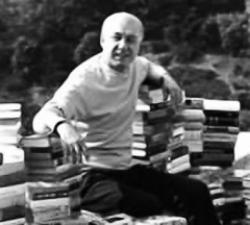
Raymond Chandler
 USA
USARaymond Chandler Biography
Raymond Thornton Chandler was born on July 23, 1888, in Chicago, Illinois. However, he spent his early years in Plattsmouth, Nebraska. After his father, an alcoholic engineer, left the family, Chandler's mother moved to Croydon, England in 1900. His successful Irish lawyer uncle provided support for Chandler and he received a classical education at Dulwich College in London. Instead of going to university, he spent time in Paris and Munich, where he honed his foreign language skills. He obtained British citizenship in 1907, joined the civil service, and worked in the Admiralty for just over a year. Tired of subservience in the civil service, Chandler resigned, shocking his family, and became a journalist for the Daily Express and Bristol Western Gazette. Although he did not achieve success in his new career, a meeting with Richard B. Middleton pushed him towards the right direction. Chandler recalls, "I met a youngish, bearded man with sad eyes, named Richard Middleton. He committed suicide in Antwerp, I should tell you. It impressed me deeply. Middleton had talent, enormous talent – the sort of talent I would never have. And if he could not make it, I was unlikely to succeed." However, it was his acquaintance with Middleton that eventually motivated Chandler to try his hand at writing. In 1912, Chandler borrowed money from his uncle and returned to America. By the end of the year, his mother joined him. In 1913, they settled in Los Angeles. In 1917, when the US entered World War I, Chandler joined the Canadian Expeditionary Force. By the end of the war, he was receiving flight training as a "goggle pilot" in the Royal Air Force. His affair with married woman Cissy Pascal, who was 18 years older than him, led to a quiet and peaceful divorce for Pascal in 1920. The lovers formalized their relationship only in February 1924, after the death of Chandler's mother, who disliked Cissy and did not give her permission for the marriage. Starting as an accountant and auditor in 1922, Chandler became the highly paid president of the Dabney Oil Syndicate by 1931. However, problems with alcohol, frequent absences, scandalous behavior with female employees, and a desire to end his own life led to his dismissal in 1932. Due to financial constraints during the Great Depression, Chandler resumed cultivating his hidden writing talents. Initially, he wrote stories for cheap magazines. His first professional work, "Blackmailers Don't Shoot," was published in Black Mask magazine in 1933. His first novel, "The Big Sleep," was released in 1939 and introduced the famous private detective Philip Marlowe to the world. Chandler's second novel, "Farewell, My Lovely," in 1940, served as the basis for three films, including "Murder My Sweet" in 1944, where audiences first encountered Marlowe. The success of his second novel and its adaptations helped Chandler transition to writing for television and film. He collaborated with Billy Wilder as a screenwriter for the film noir "Double Indemnity," which earned Chandler an Academy Award nomination. Chandler independently developed the screenplay for "The Blue Dahlia" in 1946, which also earned him an Academy Award nomination. Chandler assisted in writing the screenplay for Alfred Hitchcock's "Strangers on a Train" in 1951, based on Patricia Highsmith's novel. The tension between the writer, who found Highsmith's story highly improbable, and the director escalated to the point where they stopped speaking to each other. It is said that Chandler referred to Hitchcock as a "fat bastard," after which Hitchcock threw Chandler's writings in the trash. Nonetheless, Chandler is listed as one of the main screenwriters in the credits of "Strangers on a Train," alongside Czenzi Ormonde. In 1946, Chandler moved to La Jolla, California, where he wrote his last two novels featuring Philip Marlowe, "The Long Goodbye" and "Playback." Four chapters from an unfinished novel became the final Marlowe story, "Poodle Springs," which was written by Chandler's devoted fan Robert B. Parker. In 1954, after a prolonged illness, Chandler's wife, Cissy Chandler, passed away. Grief-stricken and deeply alcohol-dependent, the widower forgot to scatter Cissy's ashes. Her remains lay in a cupboard in the basement of the crematorium for 57 years. After his wife's death, Chandler began drowning his sorrow in alcohol, which affected his writing. In 1955, he attempted suicide, which is considered a "cry for help" as he called the police before attempting to take his own life. Sonia Orwell and Natasha Spender believed that Chandler was a closeted homosexual. Chandler regained his American citizenship in 1956. According to his death certificate, he died on March 26, 1959, from peripheral vascular collapse and prerenal uremia. His wife's ashes were finally laid to rest on February 14, 2011.