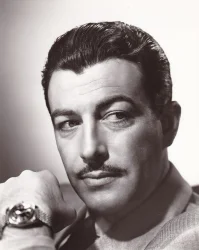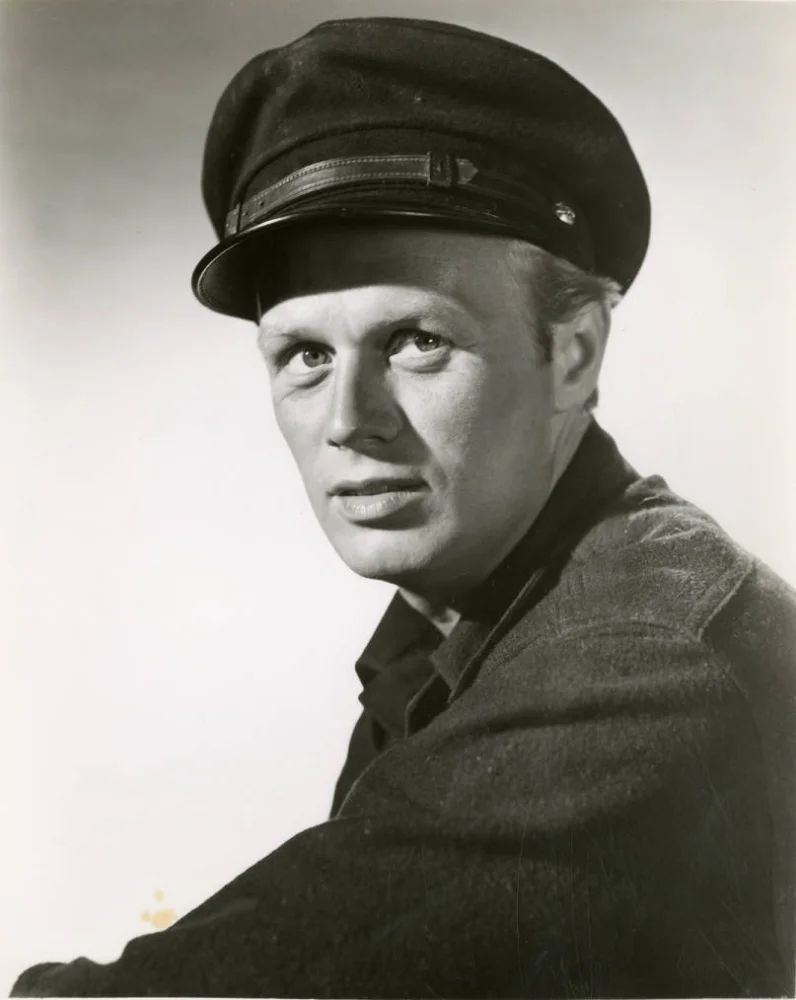
Richard Widmark
- From teaching to the stage
- Noir, westerns, and leading roles
- Producer and collaborator
- A long career beyond the first impression
Richard Widmark built a six-decade acting career by refusing to stay in one kind of role. He arrived in Hollywood with a startling performance as a giggling gangster in “Kiss of Death,” then moved through film noir, westerns, war stories, courtroom dramas, and television. The intensity of that debut made him an instant screen presence, but his later work revealed a thoughtful performer capable of both menace and quiet authority.
From teaching to the stage
Richard Weedt Widmark was born on 26 December 1914 in Sunrise Township, Minnesota. He grew up in Princeton, Illinois, and studied at Lake Forest College, where he later taught drama. Before reaching the screen, he worked in radio and developed a voice and a tightly controlled delivery that would serve him well in suspense films. He made his Broadway debut in 1943 and continued appearing on stage before signing a film contract.
His first movie role changed everything. In Henry Hathaway’s 1947 film noir “Kiss of Death,” he played Tommy Udo, a criminal whose eerie laugh and casual cruelty made the character unforgettable. The performance earned Widmark an Academy Award nomination for Best Supporting Actor and a Golden Globe as most promising newcomer. It also threatened to define him: early Hollywood repeatedly cast him as volatile villains and antiheroes.
Noir, westerns, and leading roles
Widmark quickly showed a broader range. He played a nervous hustler in Jules Dassin’s “Night and the City” (1950), a role that used his restless energy in a very different way. In Elia Kazan’s “Panic in the Streets” and Joseph L. Mankiewicz’s “No Way Out,” he took on more sympathetic parts, including a public health doctor racing to contain an epidemic and a police officer confronting racial hatred.
Western films gave him another path beyond the gangster image. He appeared in “Broken Lance,” “Warlock,” and John Ford’s “Cheyenne Autumn,” and played Jim Bowie in John Wayne’s “The Alamo.” Widmark could bring a hard edge to these characters without making them one-dimensional. His screen presence was lean and direct, well suited to stories about men under pressure.
He also made a strong impression in major dramatic and suspense films. As prosecutor Tad Lawson in Stanley Kramer’s “Judgment at Nuremberg,” he helped carry a story about responsibility for Nazi crimes. In “The Bedford Incident,” he portrayed a relentless Cold War submarine commander. In Don Siegel’s “Madigan,” he played a New York detective, a role he later reprised in a television series.
Producer and collaborator
Widmark also worked behind the camera. Through his company, Heath Productions, he produced “Time Limit” (1957), a Korean War drama in which he also starred. He produced and starred in “The Secret Ways” and “The Bedford Incident,” seeking projects that offered suspense and moral complexity. He was reportedly willing to take a direct hand in productions when he felt the film’s direction was going astray.
Across his career, Widmark worked with leading directors and actors while sustaining a distinct screen identity. His performances often paired crisp intelligence with a sense of danger, and he remained selective about the parts he accepted. In later years, he appeared less frequently, but continued to work in films and television into the 1990s.
A long career beyond the first impression
Widmark married playwright Jean Hazlewood in 1942; their marriage lasted until her death in 1997. In 1999 he married Susan Blanchard. Away from acting, he was known as a private man who valued his life outside Hollywood.
He died on 24 March 2008 at his home in Roxbury, Connecticut, aged ninety-three. Although Tommy Udo remains the performance most closely associated with his name, Widmark’s career was far wider than that notorious first role. From noir antiheroes to Western lawmen, military officers, and principled professionals, he built a body of work defined by precision, intensity, and an enduring refusal to be predictable.