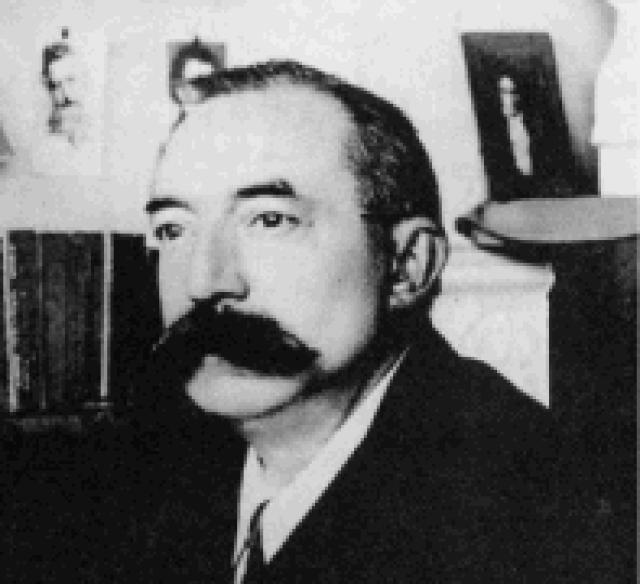
Robert Blatchford
 Great Britain
- Biography of Robert Blatchford
- Early Life and Education
- Entry into Journalism
- Establishment of "Clarion"
- Later Years and Controversies
Biography of Robert Blatchford
Robert Blatchford was an English socialist, journalist, and editor of the weekly newspaper "Clarion". He was born in Milestone during the year of the Great Exhibition. His father, John Blatchford, was a wandering comedian, and his mother, Georgina Louise Blatchford, was an actress. After his father's death in 1853, his mother continued to act on stage, and both Robert and his brother Montague helped her by participating in comedic performances.
Early Life and Education
In his youth, Robert's family constantly struggled financially. In 1862, the family settled in Halifax, where Robert began attending school sporadically while also working in a printing press, earning a mere 18 pence per week. Despite his aversion to "public school," Robert started reading at an early age, finding solace in books such as the Bible, the Pilgrim's Progress, and works by Charles Dickens. However, his mother secured a steady job as a dressmaker, and Robert and his brother became apprentices. It was during this time that Robert found himself working in a brush factory, where he met Sarah Crossley. They married in 1880.
Entry into Journalism
In 1871, Robert left Halifax, possibly due to a disagreement with his mother or a principled decision to seek a better life. He served in the army for seven years, specifically in the Dublin-based 103rd Rifle Regiment, where he essentially learned to read and write. Although he left the army in 1877, he remained in the reserve due to concerns about a potential war with Russia. After his discharge, Robert worked for a textile company. However, he grew tired of the job after his marriage, prompting the family to move to Northwich, where he attempted to pursue a career in acting. Unable to find acting opportunities, he eventually transitioned to journalism.
Establishment of "Clarion"
Robert gained recognition through his articles on the slums of Manchester, and in 1890, he established a local branch of the Fabian Society in Manchester. In 1891, he started publishing the weekly newspaper "Clarion." By 1910, the paper's weekly circulation reached 80,000 copies. In 1893, he published the best-selling book "Merrie England," and in the 1890s, both Blatchford and his newspaper reached the height of their popularity. The "Clarion" movement expanded, encompassing a socialist cycling society, a children's magazine, a scout movement, a choral society, and a songbook called "Clarion Songs" released in 1906. The audience for the newspaper grew rapidly.
Later Years and Controversies
However, Robert's political views began to shift. During the Boer War, he supported the government, and his negative stance on suffrage and religious movements limited his fan base. In the 1900s, he became a prominent British alarmist, predicting an imminent war with Germany and arguing that Germany was preparing for an immediate invasion of the British Isles. Despite the doctors' initial belief that Robert would not live long, he lived through the years of the Great Exhibition in 1851 and passed away during the Battle of Stalingrad. John Osborne believes that his long life contributed to the neglect of this vibrant personality by biographers. It is challenging to write about a person whose most significant work was published 50 years before his death.


