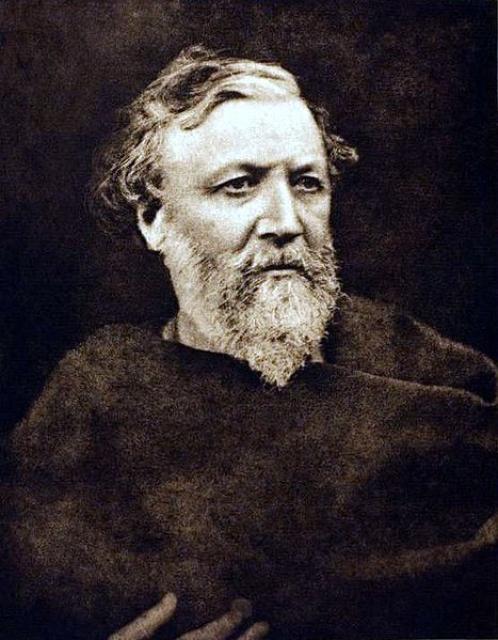
Robert Browning
 Great Britain
Biography of Robert Browning
Robert Browning was an English poet who introduced the genre of confessionary monologues into English poetry. He was born in 1812 in Camberwell, a suburb of London. His father, a small bank clerk, could have been one of the picturesque characters in Graham Greene's novels. This mild-mannered man loved to collect books on torture, magic, and alchemy. His peculiarities, sometimes clearly pathological, seemed to have emerged after a strong shock he experienced in his youth. He would turn pale at the mention of the word "blood." Naturally timid and non-vengeful, he loved to paint gruesome faces with the blood-red paint called "sanguine." Despite this, he remained carefree until his death. He showed no particular ambition in household matters or in his job, leaving all responsibilities to his wife, Sarah Anna Wiedemann, the daughter of a German and a Scotswoman. His mother ruled the household with a firm hand. The two children, Sariana and Robert, considered matriarchy as the natural form of family structure. From a young age, Robert showed a inclination for poetry and a hostility towards any demands of social discipline. Raised by Puritans who believed they alone knew the truth about all divine and human affairs, he developed a habit of passionately and categorically asserting his own opinions while refuting others, often without any basis. However, he blindly worshipped his mother and was willing to sacrifice his own tastes and preferences for her. In his early youth, he discovered Shelley and was inspired by his idea of messianic atheism. However, a single comment from Sarah Wiedemann was enough to make Robert no longer openly admire Shelley. "It is better to love than to know. Reason should simply serve the senses," he believed. His filial love compelled him to conceal his innermost thoughts. "Everyone else can say what they think, I limit myself to provoking others to conversation and extract the truth refracted through the prism of their opinions." This position restricts the freedom of the spirit but gives a special strength to the artist, teaching him to rise above passions. It suited a man who found comfort in living under his mother's care, prolonging his childhood. Even though Robert had long since become an adult, his mother continued to buy him clothes, pack his suitcases for travel, and monitor his every step. She allowed him to pursue his education as he wished, without any concern for a career. If he wanted to become a poet and couldn't make a living from it, so be it! His parents, though not wealthy, would take care of him. "Song, not service" - the choice was made. He loved his mother so much that even in his mature years, he often simply sat next to her, hugging her waist, and wouldn't go to bed until he received a motherly kiss, just like in his childhood. The door between their bedrooms remained slightly ajar at night. Their lives were intertwined: when his mother fell ill, Robert felt unwell and recovered as soon as Mrs. Browning regained her health. Their bond was even closer than the one that would later unite Madame Proust and her son Marcel. Furthermore, in the Browning family, the father never dared contradict his wife and happily played the role of another child in her presence. It could be assumed that the "mother fixation" (as it is called) would make Robert Browning incapable of loving another woman, but it turned out differently. After publishing his first, beautiful and incomprehensible poems - "Pauline" and "Paracelsus" - he began to distance himself from his parents, but not so much in practical matters as in spiritual ones. It pleased him to know that Camberwell remained a reliable refuge, with its garden of blooming roses and loving father and mother. However, he sought those who could understand him elsewhere. During this period, Browning's life resembled that of his idol Shelley. A progressive journalist named Benjamin Flower brought Robert closer to him, just as Godwin had brought Shelley closer to him. The latter fell in love with the teacher's daughter, while Browning fell in love with the beautiful and talented Eliza Flower, so fragile and passionate that friends called her Ariel. The only difference was that Shelley was attracted to very young girls whom he could "convert to his faith," while Browning sought similarities with his own mother in every woman and could not separate love from reverential devotion. Therefore, he was pleased that Eliza turned out to be nine years older than him. "Love always comes from below, the lover sees in the beloved a sublime being... Oh, how much happiness there is in adoration and submission!" Eliza had a sister, Sarah Flower, and both were worthy of love. However, Browning deemed it more appropriate to fall in love with the younger one. His beautiful face and long hair down to his shoulders made Sarah believe in the benefits of vegetarianism and the harm of "such Christian prejudice as fanatical chastity." However, feelings cannot be commanded: in Browning's opinion, Sarah lacked the attractiveness that comes with a more mature age, as well as the authority that distinguished her sister. After some hesitation, Sarah, contrary to the ideas of Shelley and Browning, chose the path of eternal chastity. Immersed in religious experiences, she later began composing psalms, one of which - "Nearer, My God, to Thee!" - became very popular in England. In 1829, Benjamin Flower died, and both of his daughters found a home in the family of their father's friend, Pastor W. J. Fox. Many writers and publishers visited their home, and young Browning met many famous literary figures there. However, it was not easy to publish his poems as they seemed completely incomprehensible - the result of intense concentration of thought. Harriet Martineau, an influential critic, wondered while reading them if she was stupid or simply going mad. But it is difficult for poems not to be obscure when the poet is in conflict with both his time and himself. Browning combined elements of Byron's rebellion and Shelley's atheism; he left a family where domestic virtues were cherished and lived in an era when Victorianism was maturing. Being misunderstood - that was the special dignity of his work. Eliza Flower, a bold girl, agreed to live in a common-law marriage with Pastor Fox, who left his lawful wife for her. Eliza distanced herself from Browning quite quickly, as she believed he was too absorbed in his art and wouldn't have enough attention for her. However, Browning couldn't do without an inspiration, but he maintained a platonic friendship with women, as long as they maintained sexual neutrality. When he turned twenty-four, his secret muse became Miss Fanny Haworth, thirty-six years old and unattractive but with an honest and intelligent face. Her unquestionable virtue was that she praised - and even understood - the poems that everyone else found incomprehensible, and she engaged in a friendly and confidential correspondence with Browning. Unfortunately, she sometimes admired things she shouldn't have, and the poet gave her a harsh response. In other words, he once again failed to find someone who could lead him, guide him - he inclined to the idea that it was impossible to love women in general. To complete his new poem, "Sordello," which takes place in Italy, he traveled around the country for some time. He was dissatisfied with his work. He became more persistent in his search for an elevated being who could guide his spiritual life, just as his mother guided his material affairs or the moon guided the movement of ocean waters. And now, upon his return to London, he came across two volumes in green bindings - "Poems" by Elizabeth Barrett. According to the bookseller, they were published while Browning was traveling and had great success. He read the poems and was deeply moved. They exuded the lofty intellect that Robert had dreamed of, with their unusual and new music, as well as bold thoughts - clear signs of maturity. Robert became overwhelmed with an irresistible desire to meet this talented woman.