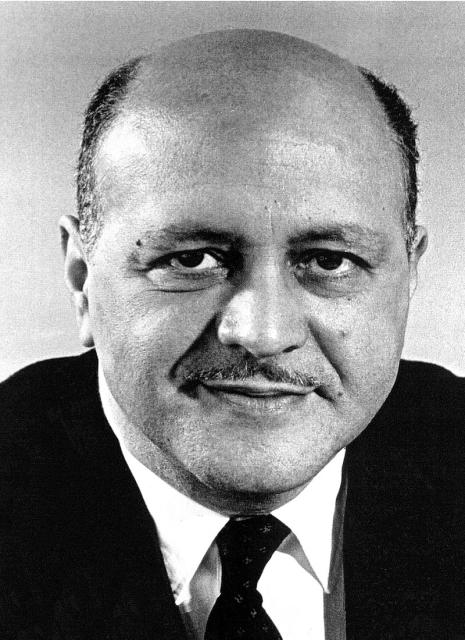
Robert Clifton Weaver
 USA
USA- Robert Clifton Weaver
- Early Life and Education
- Career in Government and Activism
- Appointments under Presidents Eisenhower and Kennedy
- Leadership in Housing
- Secretary of HUD
- Post-Cabinet Career
Robert Clifton Weaver
Robert Clifton Weaver was an American statesman who made history as the first African American to hold a cabinet position, serving as the first Secretary of Housing and Urban Development (HUD) from 1966 to 1968.
Early Life and Education
Weaver was born in Washington, D.C., and attended Harvard University, where he earned a bachelor's, master's, and doctorate in economics in 1934.
Career in Government and Activism
As part of President Franklin Roosevelt's New Deal policies, Weaver was hired in 1934 as one of 45 African Americans appointed to federal civil service positions. His government career included roles as a consultant to the Housing Authority (1937) and Executive Assistant to the National Defense Advisory Commission (1940).
After World War II, Weaver pursued a career in education, becoming a professor at New York University in 1947. He held various leadership positions within the National Association for the Advancement of Colored People (NAACP) from 1951 to 1962, including serving as its chairman from 1960 to 1962.
Appointments under Presidents Eisenhower and Kennedy
Weaver's career in public service continued under Presidents Eisenhower and Kennedy. He served as New York State Commissioner of Rent (1955-1959), consultant to the Ford Foundation (1959), and Deputy Chairman of the New York State Housing and Rent Commission (1960).
Leadership in Housing
Weaver's expertise in housing policy led to his appointment as head of the Housing and Home Finance Agency (HHFA) from 1961 to 1966. Despite opposition from Republicans, Weaver successfully implemented key initiatives during his tenure.
Secretary of HUD
In 1966, Weaver was appointed by President Lyndon Johnson as the first Secretary of Housing and Urban Development. He oversaw landmark legislation, including the Fair Housing Act of 1968, which prohibited housing discrimination based on race, color, religion, or national origin.
Post-Cabinet Career
After leaving the cabinet in 1968, Weaver served as the president of Baruch College and a professor of urban affairs at Hunter College. He continued to advocate for civil rights and fair housing throughout his retirement.